
CS2 Case Opening vs Buying Skins Directly: Which Is Better?
Published: 07.06.2026
CS2 players often face the same decision: should they open cases and accept the result, or should they buy the skin they want directly from the market? The topic of CS2 case opening vs buying skins directly matters because both options can lead to CS2 skins, but they work in very different ways.
CS2 case opening can feel exciting because the result is random. A case has an item pool, each item has a drop chance, and the final skin depends on case odds. This makes expected value, EV ratio, market value, and case opening important concepts to understand before spending money or skins.
Buying directly is more predictable. Instead of relying on a random drop, the user chooses the exact CS2 skin, market price, wear level, float value, StatTrak version, sticker combination, or pattern they want. This does not remove all risk, because skin prices can still move, but it gives the buyer much more control.
Neither option is perfect for every user. The better choice depends on your goal, budget, risk tolerance, interest in entertainment, and whether you want one specific skin or simply enjoy the uncertainty of opening cases.
The Basic Difference Between Case Opening and Buying Skins
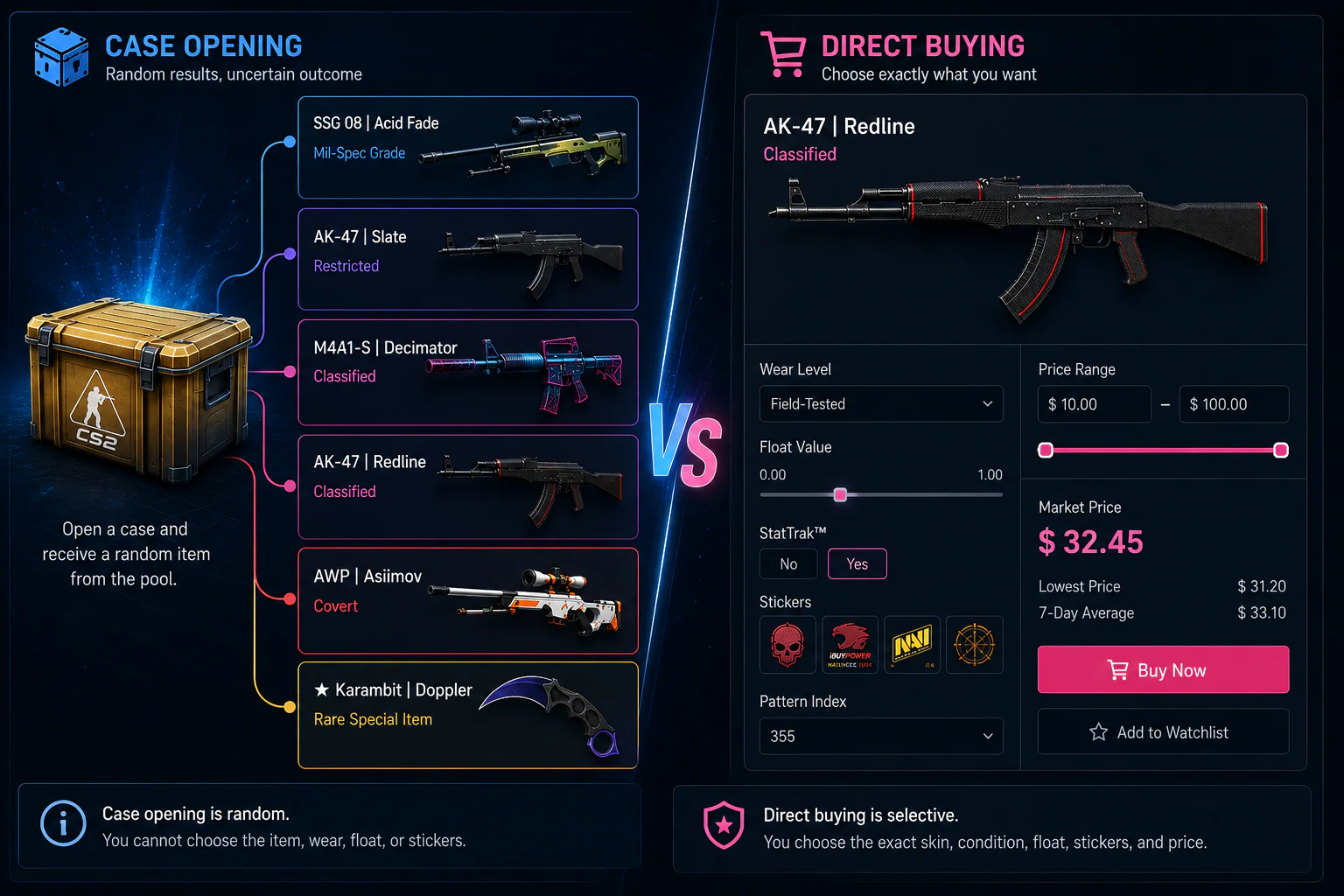
The core difference is simple: case opening is random, while buying directly is selective.
In CS2 case opening, a user opens a case that contains a set of possible items. The final result depends on case odds and drop chance. You may receive a common low-value skin, a mid-tier item, or rarely a high-value drop. The important point is that the user does not choose the final item.
Buying CS2 skins directly works differently. The user chooses the exact skin before purchase. You can compare prices, inspect float value, check wear level, look for StatTrak, review stickers, and decide whether the skin is worth the current market price.
This difference affects almost every part of the decision:
Case opening may appeal to users who value entertainment and uncertainty.
Buying directly may appeal to users who want one exact CS2 skin.
Case opening depends on probabilities.
Direct buying depends on market price and availability.
Case opening has random outcome risk.
Buying directly has price and platform risk, but not drop randomness.
Beginners should understand this difference before spending. Many new players open cases hoping for one specific item, but that target skin may have a very low drop chance or may not even be available in the case being opened. Direct buying is often easier to evaluate because the cost is visible before the purchase.
How CS2 Case Opening Works
CS2 case opening begins with a case that contains a defined item pool. To open it, the user pays the required opening cost. The case then produces one item from its pool according to the case odds.
Case odds are the probabilities assigned to the possible outcomes in a case. They describe how likely different rarity tiers or items are to appear.
Drop chance is the probability of receiving a specific item rarity tier or item type from a case. For example, a common item usually has a higher drop chance than a rare knife, glove, or high-tier skin.
The item pool usually includes different rarity levels. Lower-rarity items are more common, while rare skins and special items tend to have lower probabilities. This means the most expensive items in a case should not be treated as expected results.
After a case is opened, the market value of the drop may be lower or higher than the total opening cost. This is where expected value becomes relevant.
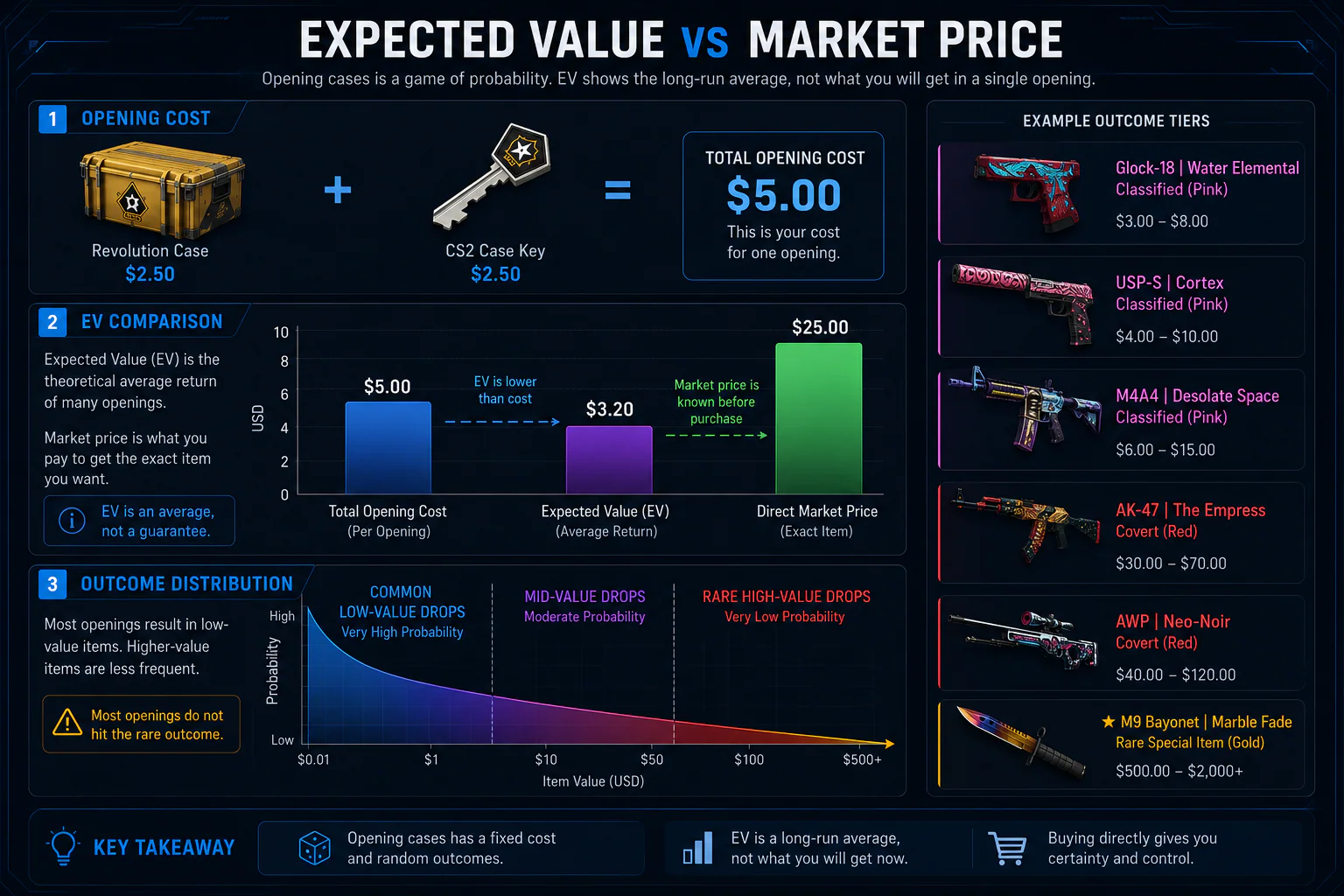
Expected value, often shortened to EV, is a theoretical average return calculated from item values and drop chances. It helps estimate what a case may return on average across many openings, based on current assumptions.
However, EV is not a prediction for one opening. A single case can produce a low-value item, a mid-value item, or a rare item. One result does not prove whether a case is “good” or “bad,” and one opening should not be treated as representative of long-term averages.
This is one of the biggest beginner mistakes: seeing a rare drop online and assuming it is a normal outcome. In reality, rare drops are rare by definition. Case opening should be understood as a random system, not a reliable way to obtain a specific skin or make money.
How Buying CS2 Skins Directly Works
A direct skin purchase means buying the exact CS2 skin you choose instead of opening a case and accepting a random result.
When buying directly, users can compare the visible market price before making a decision. They can also inspect the specific version of the skin, including its condition, float value, wear level, StatTrak status, stickers, and pattern if those details matter.
This gives the buyer more control. For example, if you want a specific AK-47 skin in Minimal Wear with a low float value, you can search for that exact type of listing. If you want a StatTrak version, you can compare StatTrak listings. If you care about sticker placement or a special pattern, you can inspect those details before buying.
Direct buying avoids random drop outcomes. You know what item you are paying for before purchase. That makes it useful when your goal is one specific skin.
Still, buying directly is not the same as having no risk. Users should compare market price, float value, wear level, seller reliability, platform reputation, and any applicable fees. Skin prices can move after purchase, and not every listing is fairly priced.
Direct buying removes drop randomness, but it does not remove market price risk.
Certainty vs Random Outcomes
Certainty is one of the strongest advantages of buying directly.
When buying directly, the user controls the main decision points. You can choose the weapon, skin condition, float range, StatTrak option, stickers, and price level. This is especially useful when the goal is ownership of one exact item.
Case opening works differently. It can produce unexpected results, which is part of the entertainment appeal. However, those unexpected results can also be disappointing. A user may receive a low-value item, a skin they do not like, or a wear level they would not have chosen.
A rare high-value item is possible in some cases, but possible does not mean likely. Users should not treat rare drops as expected outcomes, and they should not assume that repeated openings make a target skin more likely in a predictable way. Each random outcome should be understood within the odds of the case.
Random systems can also affect decision-making. After several low-value drops, some users feel tempted to continue because they want to recover what they spent. This is a common risk in random systems. A better approach is to decide the budget before opening and stop when that limit is reached.
For users who want certainty, buying directly is usually the clearer path.
Price Comparison: Case Cost vs Market Price
To compare case opening with direct buying, users should separate two types of cost: the cost to open cases and the market price of the target skin.
Case opening cost includes the case price plus the cost required to open it. If a user opens one case, the cost is simple. But if the user opens many cases while trying to obtain one exact skin, the total cost can rise quickly.
The possible reward value also varies. Many case outcomes may have a lower market value than the opening cost, while rare outcomes may be worth more. This difference creates uncertainty.
Buying directly is clearer because the skin’s market price is visible before purchase. If a skin is listed at a certain price, the buyer can decide whether that price is acceptable. There may be fees, spreads, or platform differences, but the core cost is much easier to understand.
A practical beginner question is:
Would buying the target skin directly be cheaper and more predictable than opening cases in an attempt to get it?
Often the answer is yes, especially when the target skin is rare, has a specific wear level, or belongs to a large item pool. Opening cases to get one exact skin can become expensive because the user is not only trying to hit the correct rarity tier, but also the correct item and condition.
Before opening cases for a desired skin, users should check the skin’s direct market price. If the skin is available at a clear price, direct buying may be the more controlled option.
Expected Value and EV Ratio
Expected value is one of the most important concepts in CS2 case opening analysis.
Expected value is the theoretical average return of a case based on the values of possible drops and their drop chances. It does not tell you what will happen in one opening. It estimates an average across many openings under specific assumptions.
EV ratio compares the expected value of a case to its opening cost. For example, an EV ratio below the full cost would suggest that the theoretical average return is lower than the cost of opening. The exact number depends on item prices, odds, fees, liquidity, and market movement.
EV can help users compare cases because it gives a more analytical view than simply looking at the most expensive possible drop. A case with an attractive rare item may still have weak expected value if most outcomes are low-value or if the rare item has a very low drop chance.
Negative EV is common in case opening discussions. This means the theoretical average result may be lower than the cost to open. Users should treat EV as a risk metric, not a profit promise.
Several factors can affect EV:
Current market prices of items in the case
Drop chances and rarity distribution
Platform fees or transaction costs
Liquidity and whether items can actually sell near listed prices
Changes in demand, supply, and trends
Differences in float value, wear level, stickers, and special variants
Direct buying does not require EV in the same way because the user chooses the item directly. Instead of calculating the average value of random outcomes, the buyer compares the listed market price with similar listings and decides whether the specific item is worth buying.
Drop Chance: Why Getting One Specific Skin Can Be Difficult
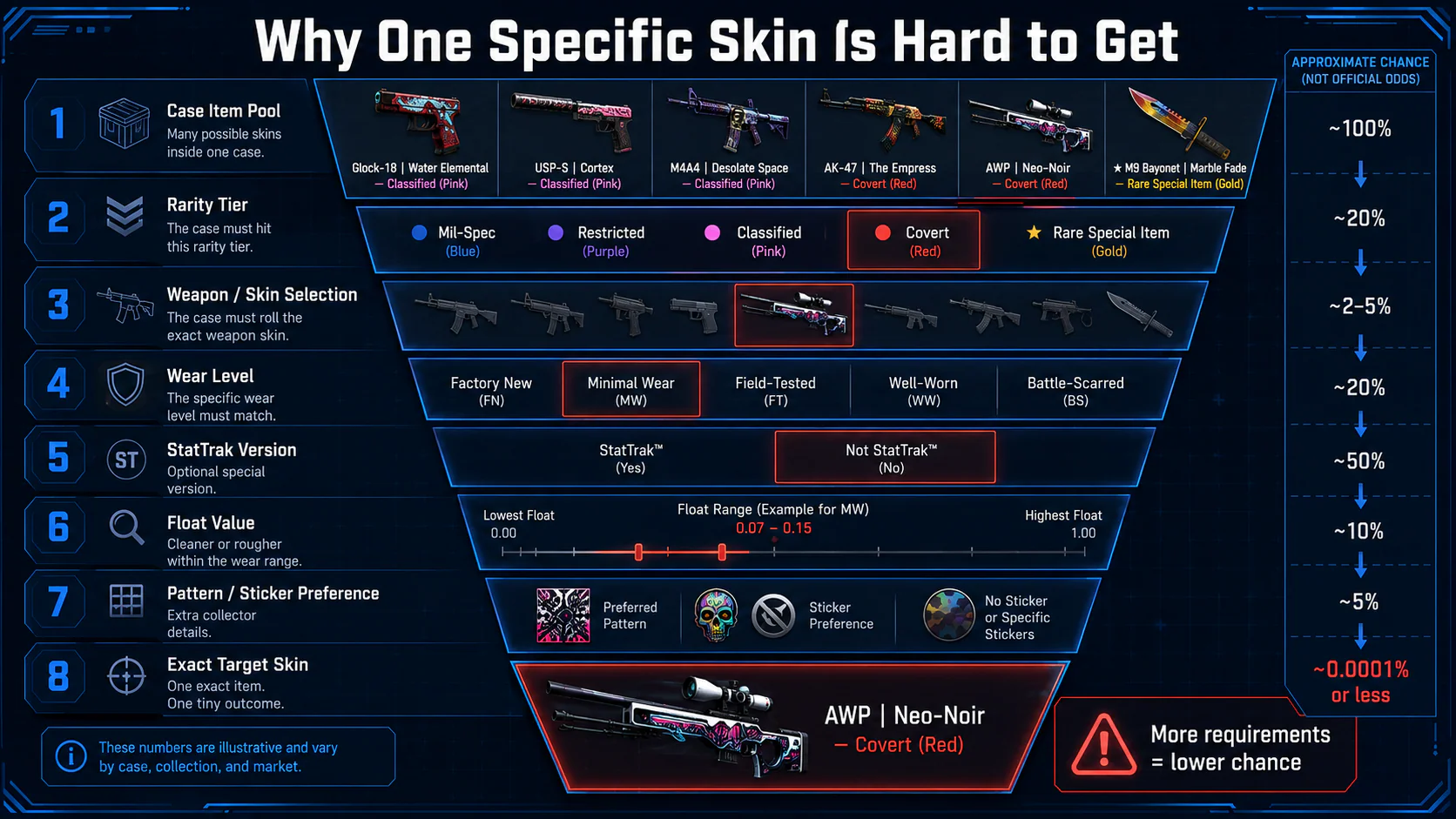
Trying to get one exact skin through case opening can be difficult because drop chance becomes more specific at every level.
First, the user needs the desired rarity tier. Then the desired skin must be selected from that tier. Then the user may care about wear level, float value, StatTrak, or a special pattern. Each added requirement makes the target outcome narrower.
Large item pools make this even harder. A case may contain many skins across several rarity tiers. Rare knives, gloves, and covert skins can be especially difficult to target because they are typically among the lower-probability outcomes.
Before opening a case for a specific item, users should check whether the skin is actually available in that case. This sounds obvious, but beginners sometimes focus on a skin they saw in a video or guide without confirming the item pool.
Repeated openings do not make a rare target “due.” Random outcomes do not work that way. Past results do not guarantee future results, and a long streak without a desired item does not create certainty that it will appear soon.
If the goal is one exact skin, buying directly is usually the better fit.
Float Value and Wear Levels
Float value and wear level are central to CS2 skin pricing.
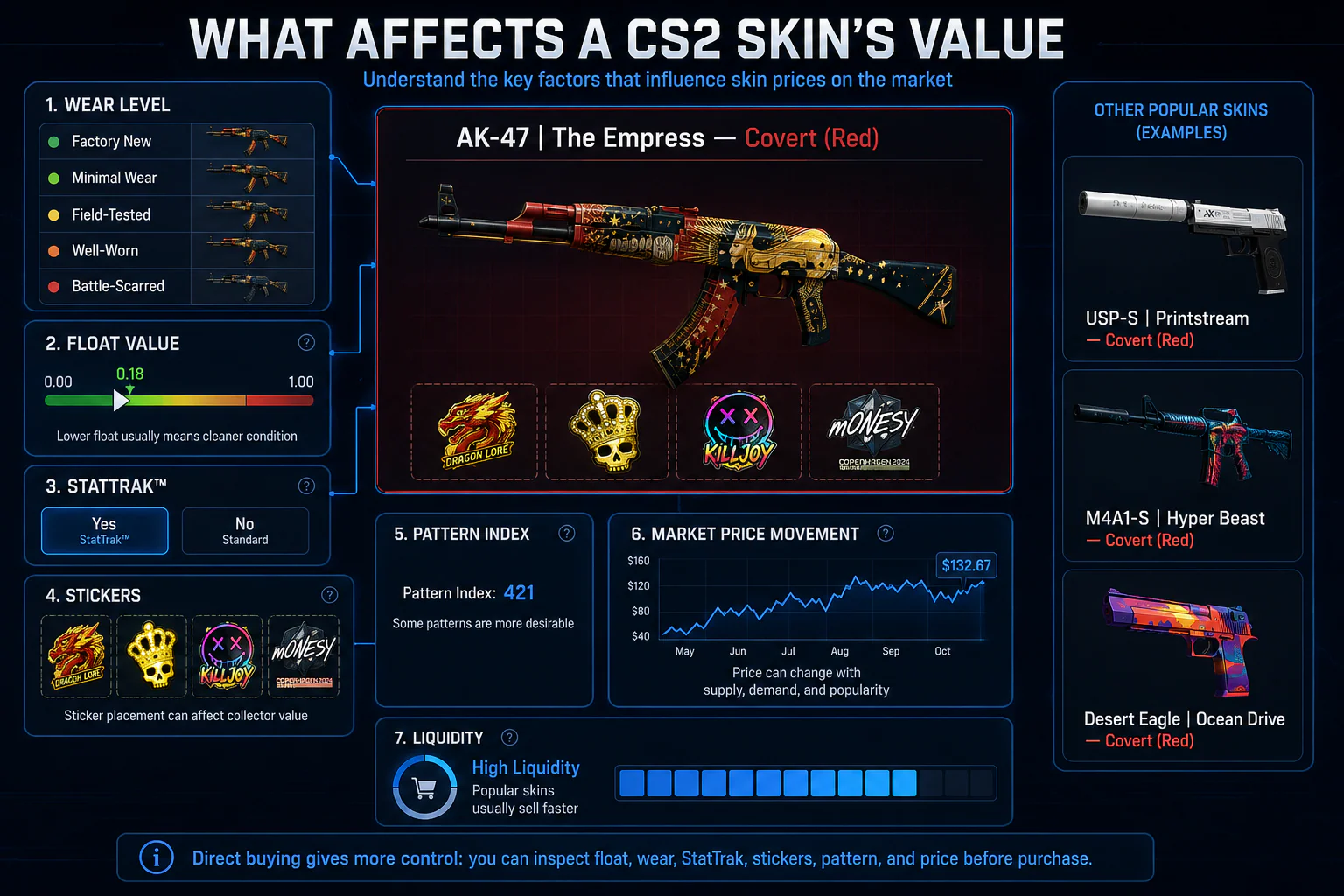
Wear level describes the general condition category of a skin. The common wear levels are:
Factory New
Minimal Wear
Field-Tested
Well-Worn
Battle-Scarred
Float value is a numeric value that determines where a skin falls within its wear range. Two skins can have the same name and same wear level but different float values. Those differences may affect appearance and market price.
For example, two Field-Tested skins may not look identical. One may have a float value near the cleaner end of the Field-Tested range, while another may look more worn. Buyers who care about visual quality often compare float values before purchasing.
Direct buying gives users more control over float value and wear level. You can search for a specific condition, inspect the float, and compare similar listings. This matters for collectors, traders, and players who care about how a skin looks in-game.
Case opening does not provide the same control. A case may drop the skin name you want but not the condition you prefer. It may also produce a float value that affects the item’s appeal or market value.
This is why two skins with the same name can have very different values. Condition, float, and visual quality all matter.
StatTrak, Stickers and Patterns
Some CS2 skins have additional value factors beyond the base skin and wear level.
StatTrak is a special version of a skin that tracks certain in-game kill counts. StatTrak versions often trade differently from non-StatTrak versions, and some users specifically prefer them.
Stickers can also affect value. A skin with certain sticker combinations, placements, or rare stickers may attract collector interest. However, sticker value can be complex. Beginners should be careful not to overpay for sticker combinations they do not fully understand.
Patterns matter for some skins. Certain pattern indexes may be more visually appealing or more collectible. Pattern-based pricing can be especially difficult for beginners because value may depend on niche collector demand rather than the base skin alone.
Direct buying gives more control over these details. You can inspect the exact item before purchase. You can compare StatTrak and non-StatTrak versions, review sticker placement, and check whether a pattern is actually valued by the market.
Case opening may not give the exact variant you want. Even if the skin itself appears, it may not have the desired StatTrak status, sticker setup, float value, or pattern.
For users who care about details, direct buying is usually more practical.
Market Value and Price Movement
Market value is the estimated price a skin can command in the market based on current supply, demand, condition, and buyer interest. It is not fixed forever.
CS2 skin prices can change for many reasons:
Supply and demand
Popularity of certain weapons
New CS2 trends
Older CS:GO skin nostalgia or collector interest
Rarity and item availability
Streamer, tournament, or community attention
Liquidity and trading volume
Changes in case popularity
Visual appeal after game updates
A skin with strong collector demand may hold value differently from a common, low-demand item. A popular rifle skin may have more liquidity than a niche weapon skin. Some expensive items may look valuable on paper but sell slowly if buyer demand is limited.
Buying directly still has market risk. A user may buy a skin and later see its price decline. A buyer may also overpay for a poor float, unpopular variant, or illiquid item.
Case opening adds another layer of risk. The user faces market risk after receiving the item, but also faces random outcome risk before receiving it. The drop may not be valuable, may not be liquid, or may not match the user’s goal.
Checking recent market context matters before buying or opening. This is where analytics, skin data, case odds, and EV-related information can help users make more informed decisions.
Risk Comparison
Both case opening and direct buying involve risk, but the risk profile is different.
Case opening risk includes random low-value outcomes. The user may spend more than the market value of the skin received. The process can also encourage emotional spending if the user keeps opening after disappointing results.
A major risk is chasing losses. If a user opens cases and receives low-value drops, continuing only to “recover” previous spending can lead to poor decisions. A fixed budget helps reduce this risk.
Direct buying has different risks. The user may overpay, choose a poor float, misunderstand wear level, buy an unpopular variant, or purchase from an unsafe seller. Market volatility can also affect the value after purchase.
Scams are relevant in both cases. Users should watch for fake sites, impersonators, phishing links, unsafe trading links, and pressure tactics. Platform trust is as important as price comparison.
In short:
Case opening risk = random outcome risk plus market risk.
Direct buying risk = market, pricing, item inspection, and platform trust risk.
Both options require research.
When Case Opening May Make Sense
Case opening may make sense for users who understand the uncertainty and treat it primarily as entertainment.
It may fit users who:
Accept random outcomes
Are not targeting one exact skin
Understand case odds and drop chance
Check case data before opening
Set a fixed budget in advance
Are comfortable receiving a low-value item
Treat EV as a risk metric, not a promise
Stop when their planned budget is used
This framing matters. Case opening should not be treated as an income method or a reliable way to get expensive CS2 skins. A rare drop can happen, but it should not be treated as the expected result.
Users who open cases should decide the budget before starting. The budget should be based on what they are comfortable spending for entertainment, not on what they hope to win back. Once that budget is used, stopping is the practical choice.
Case opening may be enjoyable for some players, but it is not the most controlled way to obtain one exact skin.
When Buying Skins Directly Is Usually Better
Buying skins directly is usually better when the user wants a specific outcome.
It is often the stronger choice when:
You want one specific skin
Float value matters
Wear level matters
StatTrak matters
Stickers matter
Patterns matter
You want to avoid random drop outcomes
The skin is available at a clear market price
You do not want to deal with drop chance
Direct buying is more predictable because the user sees the item before purchase. Instead of opening multiple cases and hoping for the desired result, the buyer compares listings and chooses.
This can be especially useful for beginners. A new player may not fully understand case odds, expected value, or item pool structure yet. Starting with a direct price comparison can make the buying decision easier to understand.
Direct buying still requires care. Users should check float, wear, platform trust, recent price trends, and whether the listed price makes sense compared with similar skins.
But when the goal is ownership of one exact item, buying directly is usually simpler and more controlled.
Common Beginner Mistakes
Beginners often compare case opening and direct buying by looking only at the best possible case drop. That creates an incomplete picture.
Common mistakes include:
Opening cases to get one exact skin
Ignoring case odds
Ignoring the specific drop chance of the target skin
Focusing only on the most expensive possible drop
Not comparing the direct market price first
Ignoring float value and wear level
Assuming StatTrak, stickers, or pattern are always worth extra
Chasing losses after low-value drops
Accepting bonus without reading terms
Assuming a rare drop is “due”
Treating case opening as an investment
Ignoring withdrawal rules
Clicking unsafe trading links
Using unfamiliar platforms without checking trust signals
A practical way to avoid these mistakes is to slow the decision down. Check the case data, compare direct prices, inspect similar listings, and decide whether the goal is entertainment or a specific skin.
For a more detailed checklist, users can read “CS2 Case Opening Mistakes Beginners Should Avoid.”
How to Decide Which Option Is Better for You
The best choice depends on what you are trying to accomplish.
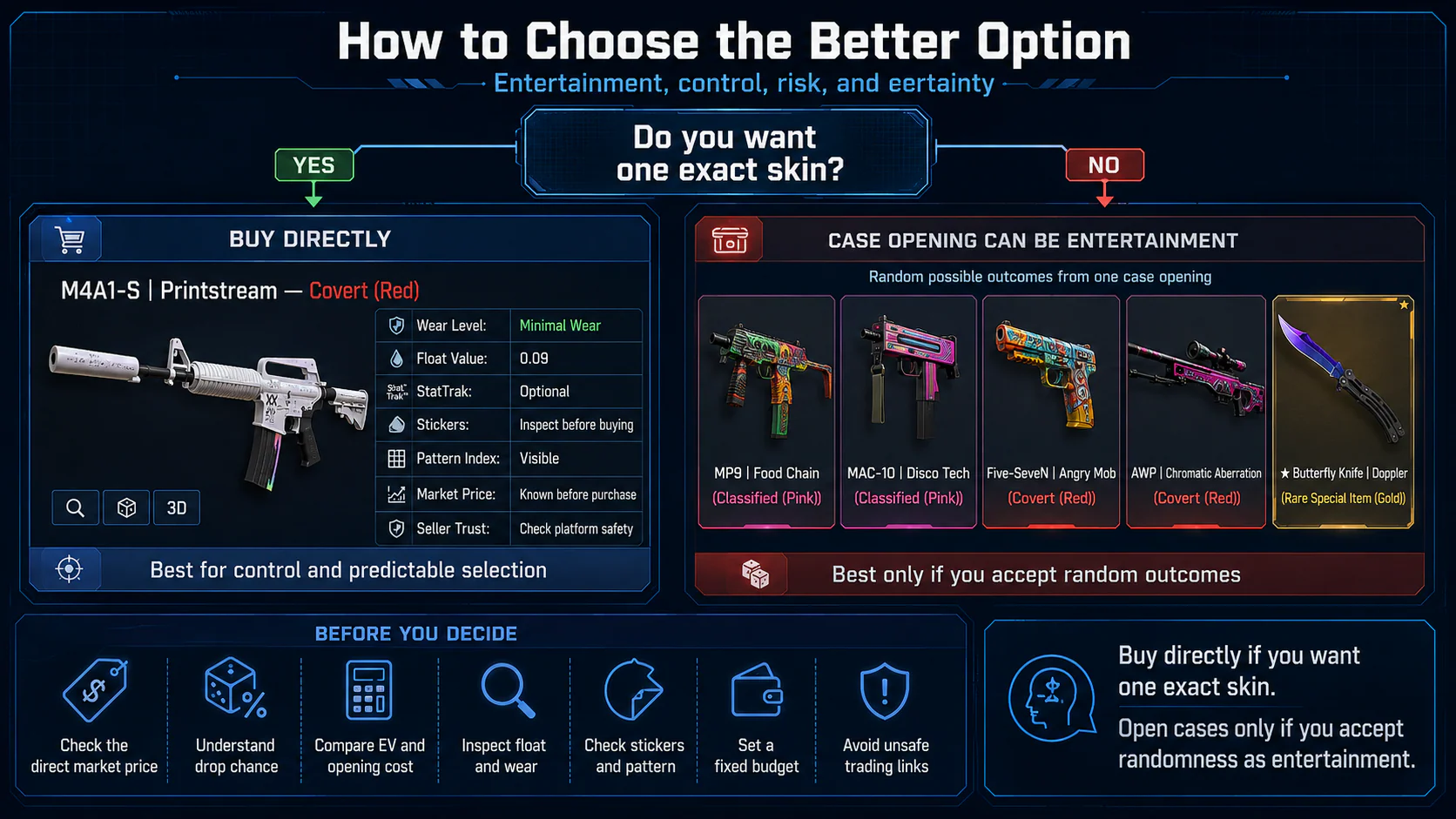
Start with the most important question: Do you want one exact skin?
If yes, direct buying is usually more logical. You can choose the skin, condition, float value, wear level, StatTrak status, stickers, pattern, and price. Case opening adds randomness to a goal that does not need to be random.
Next, ask whether you care about details. If float value, wear level, sticker placement, or pattern index matters, direct buying gives much more control.
Then compare the market price. If the skin is available at a clear price, estimate whether opening cases for it makes sense. In many situations, trying to pull one exact skin through cases can cost more than simply buying it.
If you are considering case opening, ask whether you understand the case odds. Do you know the drop chance for the item or rarity you want? Have you looked at expected value and EV ratio? Are you comfortable with receiving a low-value item?
Also consider your reason. Are you opening for entertainment, or are you trying to get a specific item? Entertainment-based opening still has risk, but the expectation is different. Trying to force a specific outcome through randomness is where many users make poor decisions.
Finally, check the platform. If using a third-party case site, review withdrawal rules, bonus terms, item delivery, and trust signals. If buying directly, compare seller reliability, market price, fees, and item details.
CS2 Case Opening vs Buying Skins Directly: Comparison Table
Factor | Case Opening | Buying Directly |
|---|---|---|
Certainty | Random result; the user does not choose the final item | High certainty; the user chooses the exact listed skin |
Cost control | Cost can increase with repeated openings | Cost is clearer because the price is visible before purchase |
Drop chance | Central to outcome; each item depends on odds | Not relevant in the same way because the item is selected directly |
Skin choice | Limited by item pool and random selection | Full control over available listings |
Float control | No direct control over the float value received | User can inspect and choose float value |
Wear level control | Wear level depends on the drop | User can select Factory New, Minimal Wear, Field-Tested, Well-Worn, or Battle-Scarred |
StatTrak choice | StatTrak depends on the random result and item availability | User can choose StatTrak or non-StatTrak listings |
Sticker or pattern choice | Very limited control; exact details are random or unavailable | User can inspect stickers, placement, and patterns before buying |
Entertainment value | Higher for users who enjoy random outcomes | Lower randomness, more practical selection |
Risk level | Higher due to random outcome risk | Lower randomness, but still has price and platform risk |
Market risk | Applies after receiving a drop | Applies after buying the selected skin |
Beginner-friendliness | Requires understanding odds, EV, and risk | Usually easier because price and item details are visible |
Best for collectors | Usually less suitable for exact collector requirements | Better for specific float, pattern, sticker, or rarity preference |
Best for one specific skin | Usually not ideal due to low specific drop chance | Usually the more predictable option |
How Chance4Skin Can Help
Chance4Skin is designed as a CS2 skin analytics and wiki-style platform for users who want to understand skins, cases, odds, and market context before making decisions.
For players comparing CS2 case opening with direct buying, Chance4Skin can help organize the important data points. Users can explore CS2 skins, review skin data, understand skin value, compare case odds, and check drop chances. This is useful because the better decision often depends on details that are easy to overlook.
Chance4Skin can also help users think about expected value and EV-related information. EV is not a promise of profit, but it can be useful for comparing the theoretical average of case outcomes against the cost of opening. When paired with market context, it gives users a clearer picture of case opening risk.
For direct buying decisions, Chance4Skin can support research into skin value, float value, wear levels, market price, and item characteristics. A user who wants a specific skin can compare the direct purchase route against the randomness of opening cases.
The goal is not to make outcomes certain. Random systems remain random, and skin markets can move. The value of Chance4Skin is in helping users make more informed beginner CS2 skin buying decisions by checking data before choosing between case opening and direct buying.
Practical Checklist Before Choosing
Do I want one exact skin?
Have I checked the skin’s current market price?
Have I compared float and wear levels?
Do I care about StatTrak, stickers, or patterns?
Do I understand the case odds?
Do I understand the drop chance for the target skin?
Have I considered expected value?
Am I opening for entertainment, not profit?
Have I set a fixed budget?
Have I checked withdrawal rules if using a case site?
Have I checked platform trust and scam risks?
Would buying directly be more predictable?
FAQ
Is it better to open CS2 cases or buy skins directly?
Buying directly is usually better if you want one exact skin, specific float value, wear level, StatTrak version, stickers, or pattern. Case opening may appeal to users who accept random outcome and treat the experience as entertainment. For most specific skin goals, direct buying is more predictable.
Is CS2 case opening profitable?
Profit is not guaranteed. CS2 case opening is random, and the value of the result can be lower than the cost of opening. Expected value can help estimate theoretical averages, but it does not predict one case result.
Why is buying skins directly more predictable?
Buying directly lets users choose the exact skin, condition, float value, wear level, and price before purchase. It removes the drop randomness that exists in case opening. Users still need to consider market price risk and platform reliability.
Can I get the skin I want by opening cases?
It is possible only if the skin is actually in the case, but the drop chance may be low. The more specific your target is, the harder it becomes to obtain through random opening. Users should check the item pool and odds before opening.
What is expected value in case opening?
Expected value estimates the average theoretical return of a case based on item values and drop chances. It is useful for comparing cases, but it does not tell you what one opening will produce. EV should be used as a risk metric, not a profit promise.
Does float value matter when buying CS2 skins?
Yes. Float value affects wear level, appearance, and often market price. Users who care about visual quality or resale context should inspect float before buying CS2 skins directly.
Are expensive cases better than cheap cases?
Not always. A higher case price does not automatically mean better value. Users should compare case odds, item pools, market prices, expected value, EV ratio, and liquidity instead of judging only by case cost.
Should beginners open cases?
Beginners should first understand case odds, drop chance, expected value, budget limits, and withdrawal rules if using a third-party case site. Case opening should be treated as entertainment with uncertain results, not as a reliable strategy for getting valuable skins. Beginners who want one specific item usually benefit from checking direct market prices first.
Can Chance4Skin help compare cases and skins?
Yes. Chance4Skin helps users understand CS2 skins, case odds, drop chances, market context, skin value, and EV-related data. This can make it easier to compare CS2 case opening vs buying skins directly before deciding which option fits your goal.
Written by
Team Chance4Skin


