
Hellcase vs Skin.Club: Best CS2 Case Site in 2026?
Published: 24.05.2026
Data note: Platform terms, withdrawal rules, case odds, bonuses, and regional availability can change. This comparison should be treated as an editorial framework checked on 24 May 2026, not as a permanent guarantee of current platform conditions.
Comparing Hellcase vs Skin.Club is not just about which site has the better design, larger bonus, or more exciting case animation. For CS2 players, the more useful comparison is whether each platform gives users enough information to understand case prices, drop odds, expected value, withdrawal conditions, and the financial risk behind every opening.
Both Hellcase and Skin.Club are third-party CS2/CS:GO case-opening platforms built around randomized skin outcomes. A user pays to open a virtual case, and the result depends on a probability system rather than a guaranteed return. That means the important questions are not only which site looks better or which platform has more cases, but how clearly the odds are shown, whether users can estimate expected value, and whether withdrawals and bonuses are explained before money is deposited.
The early verdict is straightforward. Hellcase may appeal more to users who want broad case variety and multiple platform mechanics. Skin.Club may appeal more to users who prefer a polished, CS2-focused case-opening experience. EV-focused users should compare specific cases, not only platforms. Neither platform should be treated as a reliable way to make profit.
The responsible way to compare these platforms is to evaluate the data behind the cases. Before depositing, users should verify current platform rules, item-level case odds, bonus terms, withdrawal conditions, age restrictions, Steam trade requirements, and regional availability directly on each platform. Users should also remember that a case-opening platform is not the same as a skin marketplace: paying to open a randomized case does not guarantee a skin worth the case price.
Quick Comparison: Hellcase vs Skin.Club
Factor | Hellcase | Skin.Club | What it means for users |
|---|---|---|---|
Platform type | Third-party CS2/CS:GO case-opening platform with multiple case-related mechanics. | CS2/CS:GO case-opening platform focused on virtual cases, upgrades, battles, and skin mechanics. | Both use randomized outcomes; neither is a guaranteed-value skin store. |
Case variety | May appeal to users who want a broad case-opening ecosystem. | May appeal to users who want a polished CS2-focused case-opening experience. | More cases do not automatically mean better value. |
Case price range | Usually includes low-cost, mid-range, and premium-style cases depending on current setup. | Usually includes multiple case tiers depending on current setup. | A cheap case can still have poor EV; an expensive case can still be risky. |
Odds transparency | Users should check whether item-level probabilities are visible before opening. | Users should check whether item-level odds and roll explanations are easy to inspect. | Odds visibility is essential for responsible comparison. |
Expected value | Must be calculated case by case using price, item probabilities, skin values, and withdrawal assumptions. | Must be calculated case by case using the same inputs. | The better EV platform can vary by case. |
Bonuses | May include promo codes, free cases, deposit offers, or events depending on current terms. | May include similar promotional mechanics depending on current terms. | Bonus size matters less than restrictions and withdrawability. |
Withdrawals | Users should verify Steam withdrawal rules, deposit-related withdrawal requirements, thresholds, locked balance rules, item availability, and restrictions. | Skin.Club describes skin withdrawals through Steam trade offers and states that it does not provide cash withdrawal options; users should still verify item availability, account restrictions, and regional rules. | A displayed skin value is not the same as cash value or guaranteed withdrawable value. |
User experience | May suit users who want more platform mechanics and variety. | May suit users who prefer a cleaner CS2-focused interface. | A polished interface does not remove randomized risk. |
Main caution | Variety and promotions can distract from odds, EV, and withdrawal friction. | Interface quality can make the experience smoother but does not guarantee better value. | The key comparison is case price, odds, EV, and withdrawal value. |
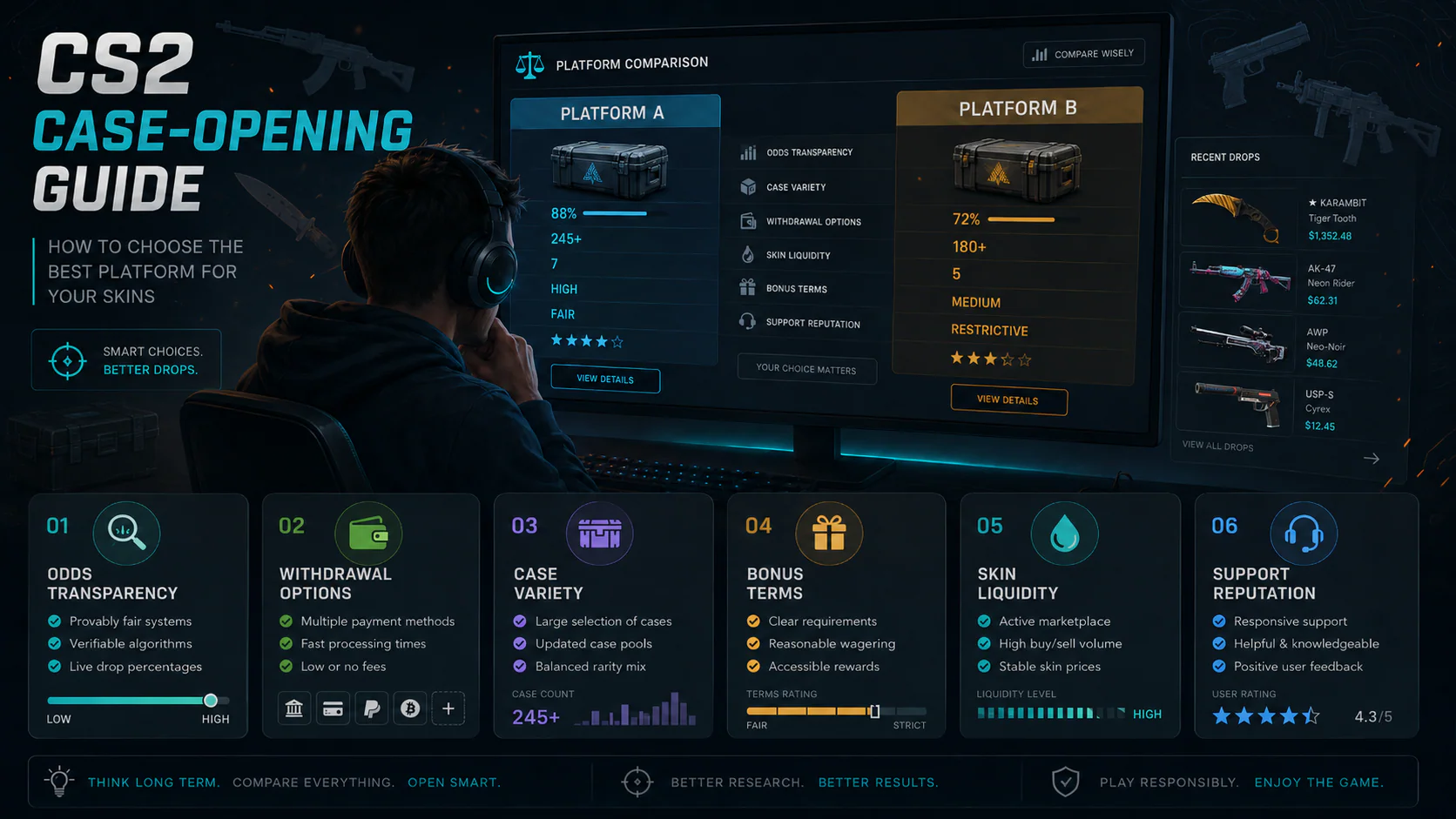
A simple winner-takes-all answer is not useful. Hellcase and Skin.Club can differ in catalog size, interface, promotions, and platform mechanics, but the most important comparison happens at the case level. Beginners should understand the case price, item pool, drop chances, and withdrawal rules. Advanced users should ask which specific case has clearer odds, better estimated EV, more liquid drops, and fewer withdrawal complications.
What Is Hellcase?
Hellcase is a third-party CS2/CS:GO case-opening platform where users open virtual cases for randomized skin outcomes. Instead of buying a specific CS2 skin directly, users select a case, pay the listed case price, and receive an outcome from that case's possible item pool.
The core experience is built around chance. A case may show low-value skins, mid-tier items, and rare high-value drops, but the presence of an expensive item does not mean the average user should expect to receive it. The probability of each outcome matters more than the headline prize.
Hellcase may include mechanics such as case battles, upgrades, contracts, or promotional features depending on the current platform setup. These features can add variety, but they can also create more ways to use balance, recycle skins, or chase better outcomes.
The main appeal of Hellcase is case variety and entertainment. The main caution is that case-opening outcomes are random, and displayed potential prizes should not be confused with average expected value. Before depositing, users should review current platform rules, published case odds, bonus conditions, withdrawal terms, account requirements, and regional restrictions. A detailed Hellcase review can help explain the platform structure, but EV-focused users should also review current Hellcase case data before judging any specific case.
What Is Skin.Club?
Skin.Club is a CS2/CS:GO case-opening platform focused on virtual cases, upgrades, battles, and skin-related mechanics. Like Hellcase, it is not the same as buying a specific skin directly from a marketplace. Users interact with randomized case-opening products, platform balance, skin inventories, and related features that depend on current platform rules.
The basic flow is similar to other CS2 case-opening platforms. A user selects a case, opens it, and receives a CS2 skin or platform-based outcome depending on the case structure and terms. The result is determined by a probability system, not by user choice after payment.
Skin.Club's appeal is often tied to visual presentation, recognizable branding, and a CS2-focused case-opening experience. Users who prefer a polished and focused interface may find it easier to navigate. However, presentation should not be mistaken for lower risk. A clean interface does not change the underlying economics of randomized outcomes.
The main caution with Skin.Club is the same core caution that applies to CS2 case-opening sites in general: outcomes are random, expected value may be negative, and practical value depends on whether the item can be withdrawn, sold, exchanged, or used under current platform rules. Users comparing Skin.Club should verify current rules directly on the platform and review Skin.Club case data instead of relying only on design, branding, or promotional messaging.
Hellcase vs Skin.Club: Main Differences
The main differences between Hellcase and Skin.Club are best understood through product positioning, user flow, case selection, promotional mechanics, transparency, withdrawal experience, and user control before depositing. Still, the biggest difference is not always the platform brand. In many cases, the most important difference is the specific case a user chooses.
Hellcase generally positions itself as a broad case-opening platform with many case types and related mechanics. Skin.Club generally positions itself as a CS2-focused case-opening experience with polished presentation and skin-centered mechanics. Neither positioning automatically makes one platform better.
A broad product can be useful for users who want variety, but it can also be harder to evaluate. A polished CS2-focused product can be easier to navigate, but it still requires odds and EV analysis. Faster openings, strong animations, prominent rare drops, and easy balance recycling can make users spend more than intended, so interface quality should be judged by how clearly it explains costs, probabilities, and limits.
Both platforms may use promotional mechanics such as bonuses, promo codes, free cases, missions, events, battle incentives, or deposit-related rewards. The important question is not only whether a bonus exists. Users should ask whether the bonus is withdrawable, whether wagering rules apply, when it expires, which cases are eligible, and whether it changes withdrawal eligibility.
Transparency includes published odds, item pools, pricing, fairness explanations, roll history, bonus terms, and withdrawal rules. The strongest platform for a risk-aware user is the one that lets users inspect case prices, item pools, drop chances, bonus terms, and withdrawal rules before committing funds.
Case Variety and Pricing
Case variety is one of the first things users notice when comparing Hellcase and Skin.Club, but it is not the same as value. A platform can offer a large catalogue and still have cases that are difficult to evaluate, highly volatile, or unattractive from an expected value perspective.
More cases simply means more choices. It does not automatically mean better odds, better pricing, better withdrawals, or better long-term outcomes. A cheap case can still have poor expected value if most probability is assigned to skins worth much less than the case price. Cheap cases can also encourage repeated openings, which may lead users to spend more than planned.
An expensive case can be even more volatile. A premium case may show high-value knives, gloves, or rare rifle skins, but that does not mean those items are likely outcomes. If most probability is assigned to lower-value skins, the user is still taking a high-risk chance on a rare result.
Users should compare case price, full item pool, item-level probabilities, current skin prices, wear and condition assumptions, sell-back value where available, withdrawal value, item liquidity, and platform restrictions. The same skin can have different practical value depending on float, wear, demand, Steam restrictions, and platform inventory.
Chance4Skin's CS2 case database can help users compare case-level information more systematically instead of relying only on platform presentation. The CS2 skin database is also important because case value depends on the skins inside the case. For platform-specific research, users can compare Hellcase case data and Skin.Club case data to see how individual cases differ by price, contents, probabilities, and possible outcomes.
Odds Transparency: Which Platform Is Easier to Evaluate?
Odds transparency is one of the most important factors in any Hellcase vs Skin.Club comparison. Without clear odds, users cannot reasonably estimate expected value, compare risk, or understand what they are paying for.
A useful CS2 case odds comparison should focus on item-level probabilities. It is not enough for a case page to show attractive skins, rare knives, gloves, or covert items. Users need to know how likely each result is. The real question is not whether a case can drop a knife; it is how much probability is assigned to the knife compared with low-value outcomes.
A case can display an expensive top prize while assigning that item an extremely low probability. If most openings are likely to return low-value skins, the case may still have poor expected value even though the top prize looks impressive.
Users should check whether the platform shows the full item pool before opening, whether each item has a visible probability, whether wear or condition variations are explained, and whether an RNG or provably fair explanation is available. A provably fair system, when implemented clearly, can help users verify that a roll was generated according to the platform's stated randomness process.
However, provably fair should not be misunderstood. It does not automatically mean high expected value, low risk, or likely profit. It only addresses whether the random outcome can be verified according to the platform's fairness system. A case can be provably fair and still assign most probability to low-value outcomes.
Expected Value: The Most Important Metric for Serious Comparison
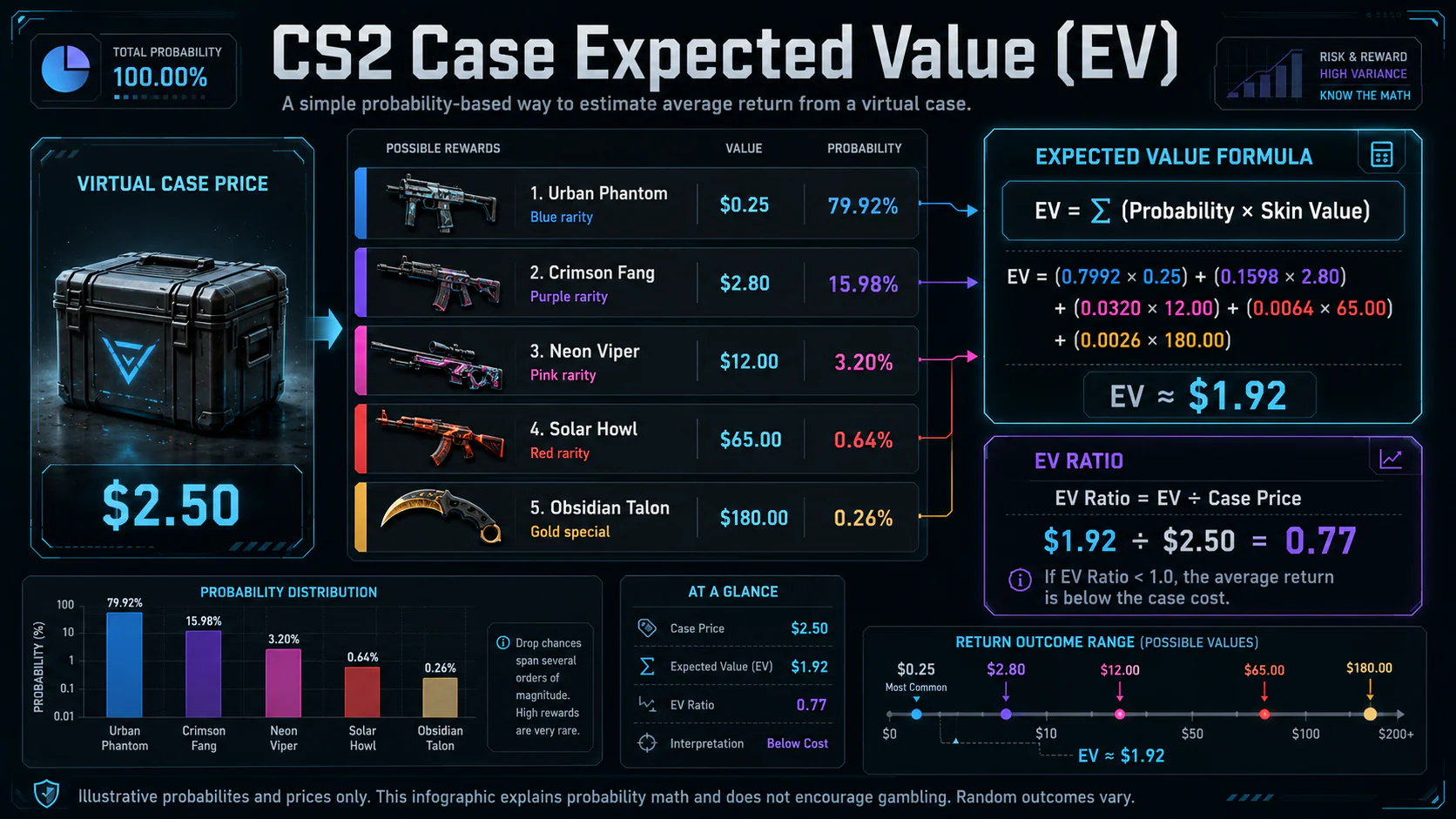
Expected value is one of the most important metrics in any serious Hellcase vs Skin.Club comparison. Design, bonuses, case variety, and opening animations affect user experience, but they do not explain whether a case is priced reasonably relative to its possible outcomes.
In simple terms, expected value estimates the average theoretical return of a case based on item probabilities and skin prices. It asks: if this case were opened many times under the same conditions, what would the average return be before considering fees, withdrawal limits, liquidity, or price changes?
Expected value does not predict what will happen in one opening. A user can open a case with strong estimated EV and still receive a low-value item. Another user can open a poor-EV case and hit a rare high-value item. Neither individual result proves that the case is good or bad.
For a basic CS2 case expected value calculation, each possible item is weighted by its probability and realistic skin value: item probability x item value = expected contribution of that item. Add the expected contribution of every possible item, and the result is the case's total expected value.
To compare that number against the case price, users can calculate an EV Ratio: EV Ratio = Total Expected Value / Case Price. An EV Ratio below 1.00 usually means the theoretical return is lower than the case price. An EV Ratio around 1.00 means the theoretical return is close to the case price before fees, liquidity issues, withdrawal friction, and market-price uncertainty. An EV Ratio above 1.00 may look attractive, but users must still check withdrawal rules, market pricing, platform fees, sell-back values, item availability, and liquidity.
This is why EV-focused users should not ask only which platform is better. A proper CS2 case EV comparison between Hellcase and Skin.Club should happen at the case level. One Hellcase case might have a better EV Ratio than one Skin.Club case, while another Skin.Club case might compare better than a different Hellcase case.
A platform with more cases does not automatically have better EV. A platform with attractive design does not automatically have better EV either. Expected value is determined by case price, item pool, item probabilities, and real skin value. EV analysis can help users understand risk, but it does not make case opening safe or reliably profitable.
Withdrawals and Real Skin Value
Winning a skin and withdrawing a skin are not the same thing. This distinction is important because the value shown during or after a case opening may not equal the value a user can realistically access outside the platform.
A case result may look profitable on-screen, but users still need to ask whether the item can be withdrawn, how quickly it can be withdrawn, whether the exact item is available, and whether account or trade restrictions apply. Users should check Steam withdrawal availability, trade holds, minimum withdrawal thresholds, locked balance rules, withdrawal fees, account verification requirements, regional restrictions, item availability, failed trade handling, and liquidity.
Displayed skin value can also differ from actual market value. A platform may show an estimated price, but that estimate may not match what the skin can sell for quickly on Steam, third-party marketplaces, or peer-to-peer markets. Market value depends on demand, wear condition, float, stickers, supply, and buyer interest.
For both Hellcase and Skin.Club, users should verify current withdrawal rules directly on the platform before depositing. They should also avoid assuming that every displayed item value is equivalent to cash value.
Bonuses and Promotions
Bonuses can make a platform look more attractive, but they can also reduce user control. Promo codes, deposit bonuses, free cases, daily rewards, rakeback, affiliate offers, missions, and event campaigns may appear valuable at first glance. The real question is how usable that value is.
Headline bonus size is often less important than the conditions attached to it. A large bonus with restrictive terms may be less useful than a smaller, clearer offer. Important conditions include wagering requirements, withdrawal restrictions, expiration dates, eligible cases, minimum deposits, locked balance rules, maximum withdrawal limits, account verification requirements, and restrictions on bonus-derived winnings.
Bonus hunters should avoid judging Hellcase vs Skin.Club by promo size alone. A bigger bonus may come with more restrictions, while a smaller bonus with transparent rules may be easier to evaluate. Bonuses should never be treated as guaranteed profit or as a reason to deposit more than planned. Users should verify current rules directly on each platform and treat any bonus as conditional value until the terms are clearly understood.
User Experience and Interface
User experience matters in a Hellcase vs Skin.Club comparison, but it should be evaluated through a practical lens. A good interface is not only attractive. It should help users understand what they are doing, what they are paying, what they can win, and what risks apply before opening cases.
Navigation should make it easy to find cases, account settings, deposit options, withdrawal pages, support resources, bonus terms, and fairness information. Case pages should make it easy to inspect the case price, possible drops, item probabilities, and relevant conditions. Mobile usability matters because smaller screens can hide important details behind menus.
Deposit flow should be clear and deliberate. Users should understand payment method, amount, currency, fees, bonus eligibility, and restrictions before confirming a deposit. Withdrawal flow is equally important: users should be able to see what items are withdrawable, what requirements apply, and what steps are needed to complete a trade.
A polished interface should not replace due diligence. A platform can look professional while still exposing users to randomized outcomes, negative EV, bonus restrictions, or withdrawal friction. Design quality may make a platform more pleasant to use, but it does not make case opening predictable or reliably profitable.
Safety, Legitimacy, and Risk
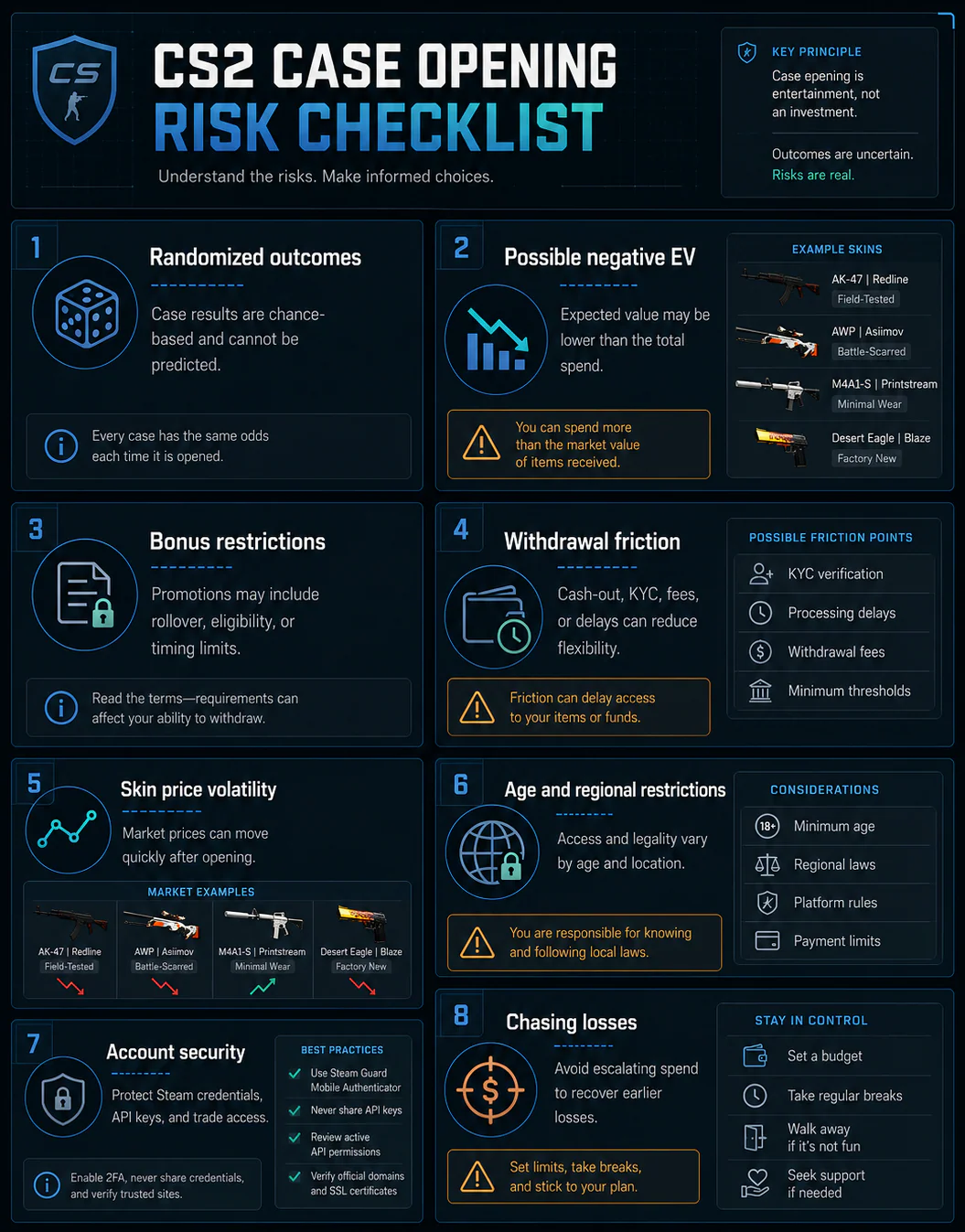
Legit does not mean low-risk. A CS2 case-opening platform may process deposits, show case odds, deliver skins, and operate a functioning website while still exposing users to meaningful financial risk.
A platform can deliver skins and still have cases with negative expected value. It can offer withdrawals and still have withdrawal friction. It can provide bonuses and still attach restrictions that make the bonus less useful than it appears.
Users should evaluate reputation, terms of service, support quality, fairness or provably fair systems, country restrictions, age requirements, responsible-use tools, account limitations, withdrawal rules, bonus terms, and Steam trade requirements. None of these signals should be treated as absolute proof that a platform is safe. They are risk indicators.
Country restrictions and age rules matter because CS2 case opening can resemble gambling-like activity. Users should check whether they are legally allowed to use the platform in their location and whether they meet the platform's minimum age requirements.
There is also behavioral risk. Case opening can encourage users to chase losses, reopen with remaining balance, use bonuses impulsively, or keep trying for a rare drop after receiving low-value outcomes. Users should avoid depositing money they cannot afford to lose and stop if they feel pressured to recover previous losses. For a deeper risk framework, users should review CS2 case opening risks before comparing any specific platform.
Best Platform by User Type
Beginners
For beginners, the better platform is the one where the full cost, odds, bonus terms, and withdrawal conditions are easiest to understand before opening a case. Beginners should not choose based on the largest bonus or most exciting animation. If they choose to use either platform, they should keep exposure small, avoid chasing losses, and never deposit money they cannot afford to lose.
EV-Focused Users
EV-focused users should not ask only Hellcase or Skin.Club. They should ask which specific case has better EV, whether item probabilities are visible, whether the case price is fair relative to the item pool, whether listed skin prices are realistic, and whether the resulting skins can be withdrawn. Chance4Skin's case and skin data can support this type of case-by-case comparison.
Skin Collectors
Skin collectors should compare item pools rather than platform branding. They should evaluate specific skin availability, wear levels, float ranges, finish quality, liquidity, Steam inventory compatibility, and withdrawal reliability. For collectors who want a specific skin, direct marketplace buying is usually more predictable than randomized case opening.
Bonus Hunters
Bonus hunters should compare real practical value, not headline promo size. Wagering requirements, eligible cases, expiration dates, withdrawal restrictions, maximum conversion, and locked balance rules can reduce or eliminate the usefulness of a large offer. Bonuses can also encourage higher spending and may not improve actual expected value.
Hellcase vs Skin.Club: Pros and Cons
Hellcase Pros
Broad case-opening ecosystem.
Recognizable platform in the CS2 case opening space.
Multiple game-like mechanics depending on current setup.
Useful for users who want variety.
Hellcase Cons
Randomized outcomes.
Promotions may be complex.
Users must verify odds and withdrawal rules.
Popularity does not guarantee better EV.
Skin.Club Pros
Polished CS2 skin-opening experience.
Recognizable platform.
Strong focus on CS2/CS:GO skins.
May appeal to users who value interface and simplicity.
Skin.Club Cons
Randomized outcomes.
Users must check withdrawal rules and real value.
Bonuses may have restrictions.
Interface quality does not guarantee better odds.
Common Mistakes When Comparing Hellcase and Skin.Club
Common mistakes include choosing based only on bonus size, ignoring EV, looking only at the most expensive possible prize, assuming cheap cases are safer, assuming popular platforms always have better odds, ignoring withdrawal rules, forgetting that displayed value may differ from real market value, and depositing before reading terms.
The safest analytical habit is to compare the specific case first. Users should inspect price, item pool, item-level odds, realistic skin value, bonus eligibility, and withdrawal rules before opening anything. If the information is unclear, users should not assume the most favorable interpretation.
Final Verdict: Hellcase vs Skin.Club
The most balanced answer to Hellcase vs Skin.Club is that neither platform is universally better for every user. The better choice depends on what the user values and how carefully they evaluate specific cases.
Hellcase may be better for users who value variety and a broader case-opening ecosystem. Skin.Club may be better for users who value a polished CS2-focused experience. For EV-focused users, the brand-level comparison is not enough. They should compare individual cases rather than relying on assumptions about which platform is better.
Risk-sensitive users should prioritize odds transparency, small exposure, and withdrawal clarity. They should look for visible item-level probabilities, realistic skin values, clear withdrawal rules, and understandable bonus terms before opening any case.
Neither platform should be considered a reliable income source. CS2 case opening involves randomized outcomes, variance, potential negative expected value, bonus restrictions, withdrawal friction, and market-price uncertainty. The most responsible approach is to treat case opening as high-risk entertainment and compare case data before spending money.
FAQ
Is Hellcase better than Skin.Club?
Hellcase may be better for users who want broader case variety and more platform mechanics. Skin.Club may be better for users who prefer a polished CS2-focused interface. The better choice depends on specific cases, odds, prices, withdrawal rules, and user priorities.
Is Skin.Club safer than Hellcase?
Skin.Club should not be described as automatically safer than Hellcase. Safety depends on current platform rules, odds transparency, withdrawal conditions, account security, country restrictions, and user behavior. Neither platform should be treated as risk-free.
Which platform has better CS2 case odds?
The platform with better CS2 case odds depends on the specific case being compared. Users should check item-level probabilities, not just rare prizes shown on a case page.
Which platform has better expected value?
Expected value varies by case. Users should compare case price, item probabilities, real skin value, and withdrawal conditions instead of relying on brand-level assumptions.
Can you withdraw CS2 skins from Hellcase and Skin.Club?
Both platforms may offer skin withdrawal features depending on current rules and item availability. Users should verify the latest withdrawal process, thresholds, Steam trade requirements, and account restrictions directly on each platform before depositing.
Are Hellcase and Skin.Club legit?
Both are recognizable names in the CS2 case-opening space, but legit does not mean low-risk or profitable. Users should evaluate terms of service, support quality, fairness systems, withdrawal rules, and restrictions before using either platform.
Are CS2 case-opening sites risky?
Yes. CS2 case-opening sites involve randomized outcomes and financial risk. Users can receive items worth less than the case price, and bonuses or withdrawals may include restrictions.
Should beginners use Hellcase or Skin.Club?
Beginners should use neither platform unless they understand the full cost, odds, and withdrawal conditions. If they choose to use one, the better option is the platform where rules, item probabilities, bonus terms, and withdrawal steps are easiest to understand.
What is the best way to compare CS2 case-opening sites?
The best way is to analyze specific cases. Users should compare case price, item pool, item-level odds, expected value, skin market prices, withdrawal rules, bonus conditions, and platform transparency.
Can you make profit from CS2 case opening?
A user can occasionally receive a skin worth more than the case price, but CS2 case opening should not be treated as a reliable way to make profit. Outcomes are randomized, variance is high, and expected value may be negative after fees, withdrawal friction, and market-price differences.
Written by
Team Chance4Skin


