
CS2 Case Odds: How Drop Chances Really Work
Published: 06.05.2026
Updated: 24.05.2026
What Are CS2 Case Odds
CS2 case odds are the probabilities behind the item rarity you receive when you open a Counter-Strike 2 weapon case. A case contains a fixed set of possible skins, but the game does not choose from those skins with equal probability. Instead, the system first weights items by rarity tier, which means the lower tiers appear far more often than the high-value tiers.
For a player, this means the explanation is less important than the probability table behind it. Most openings land on a blue Mil-Spec item. Fewer land on purple Restricted items. Pink Classified items are uncommon, red Covert items are rare, and gold Rare Special items are extremely rare. The market value of a skin is related to rarity, but rarity is not the only variable. Demand, supply, finish, float, pattern, StatTrak availability, and current market conditions all matter.
Each case opening is an independent event.
A losing streak does not make the next case more likely to contain a knife.
A high-value item can appear early, but that is luck, not a predictable pattern.
The odds describe long-run averages, not guaranteed short-run outcomes.
This distinction is important for anyone evaluating whether to open cases or buy skins directly. Odds explain the chance of each rarity tier, but they do not tell you whether the result will be worth more than the cost of the case and key.
Rarity Tiers Explained
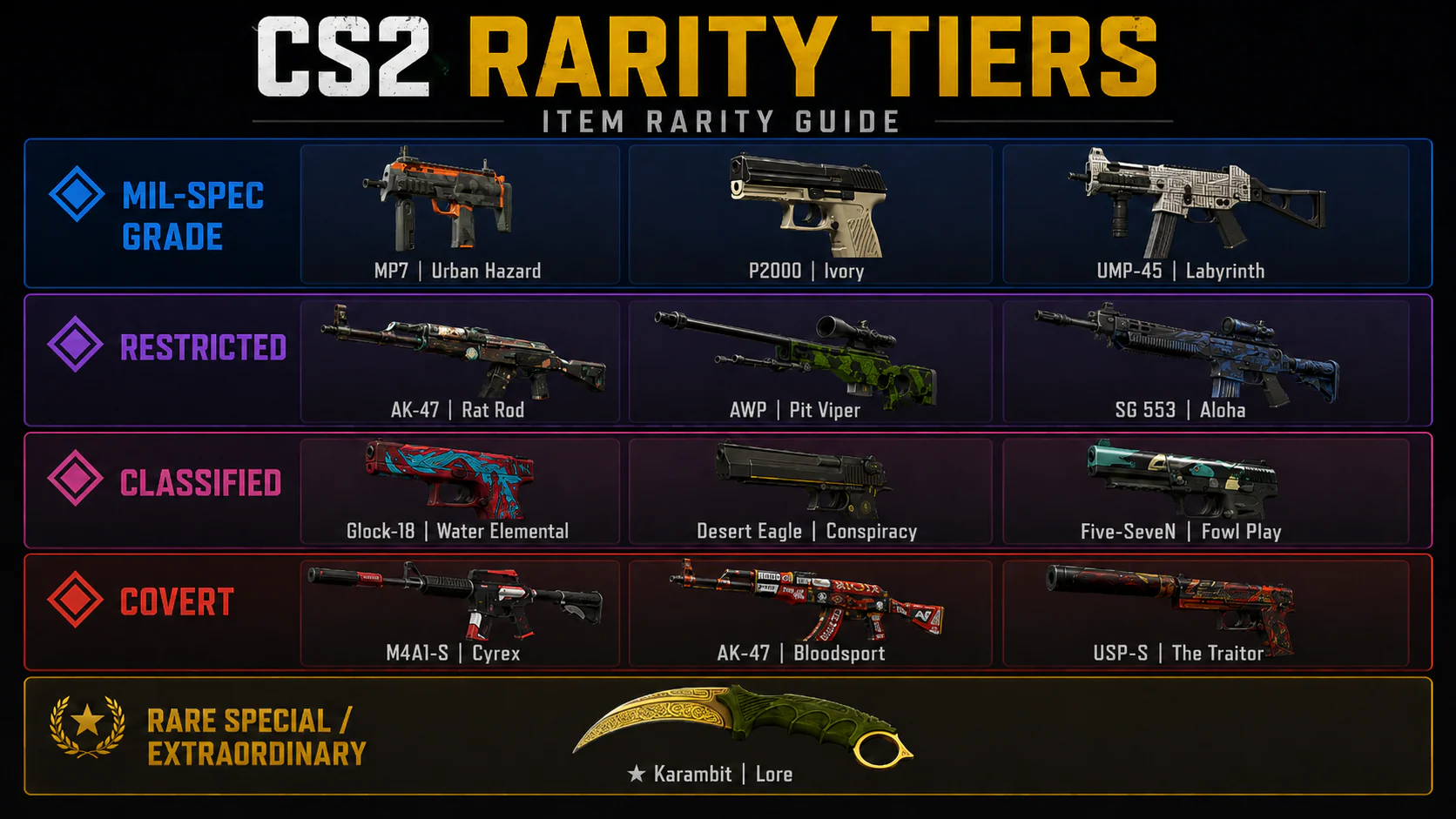
Standard CS2 weapon cases use five major rarity outcomes: Mil-Spec, Restricted, Classified, Covert, and Rare Special. The names are familiar to most players, but the practical difference between them is probability. Every step up the rarity ladder is much less likely than the tier below it.
Mil-Spec
Commonly accepted estimate: approximately 79.92%. Mil-Spec items are the most common standard case drops. They are usually blue and represent the majority of outcomes. In practical terms, a player should expect most case openings to produce this tier over a large sample. Mil-Spec items can still have value in unusual cases, especially when a skin has trade-up demand or a very desirable float, but rarity alone makes them the baseline result.
Restricted
Commonly accepted estimate: approximately 15.98%. Restricted items are the purple tier. They are less common than Mil-Spec items, but still frequent enough to appear regularly across a modest number of case openings. Restricted skins often look more distinctive than Mil-Spec skins, yet many still sell below the combined case and key cost.
Classified
Commonly accepted estimate: approximately 3.20%. Classified items are the pink tier. This is where the opening starts to feel meaningfully rare. A Classified item can be exciting, but it is still not a guaranteed profitable result. Some Classified skins perform well because they are used in trade-up contracts or have strong demand; others remain relatively inexpensive.
Covert
Commonly accepted estimate: approximately 0.64%. Covert items are the red tier and are among the rarest normal weapon skins in a case. Many famous case skins are Covert items, but the tier itself should not be confused with guaranteed value. The drop is rare, yet the market still prices each item based on supply, demand, float, finish popularity, and broader trading trends.
Rare Special Items (Knives and Gloves)
Commonly accepted estimate: approximately 0.26%. Rare Special items are the gold-tier outcomes. Depending on the case, this tier can include knives or gloves. The commonly accepted estimate is approximately 0.26%, which is why unboxing a knife or gloves is so uncommon. This number is often simplified to about one Rare Special item per 385 openings on average, but that average is not a guarantee.
Real Drop Rates in CS2
The following table uses widely known and commonly accepted estimates for standard CS2 weapon case rarity odds. The values are approximate and should be presented as commonly accepted estimates because most public discussion relies on historical Valve and Perfect World disclosure context plus community repetition, rather than a live public probability table for every current case.
Rarity Tier | Color | Probability |
|---|---|---|
Mil-Spec | Blue | Approx. 79.92% |
Restricted | Purple | Approx. 15.98% |
Classified | Pink | Approx. 3.20% |
Covert | Red | Approx. 0.64% |
Rare Special | Gold | Approx. 0.26% |
The table also shows why case opening has such a skewed distribution. A player is far more likely to receive a low-rarity item than a premium item. Even if a case contains a very expensive knife, the probability of reaching the Rare Special tier is extremely low.
Expected Value Calculations
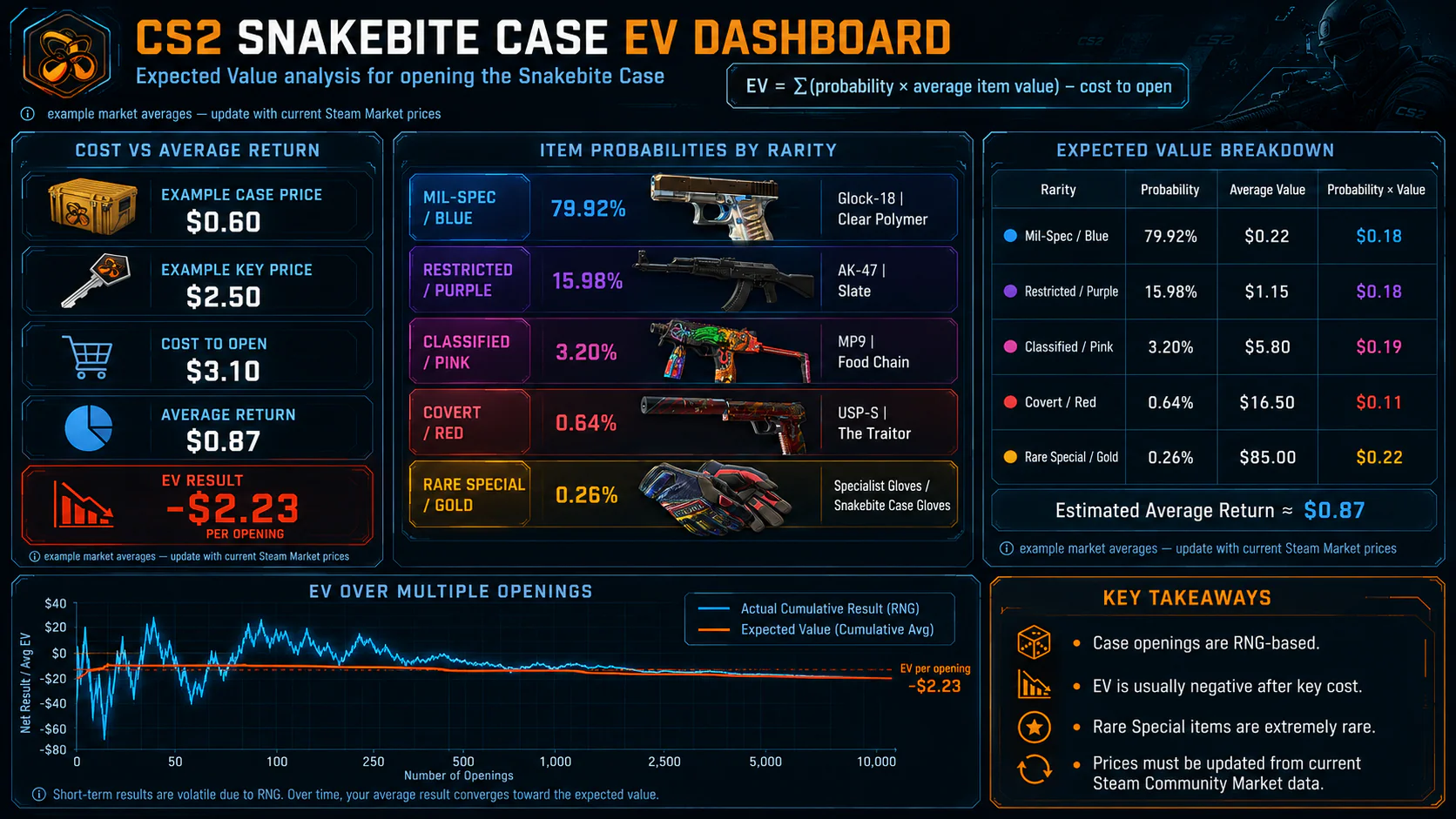
Expected value, usually shortened to EV, is the average financial result you would expect if the same action were repeated many times. For CS2 cases, EV compares the cost of opening a case with the probability-weighted value of the possible outcomes. It is not a prediction for one opening. It is a long-run average.
A simple EV formula is: EV = sum of probability times average outcome value, minus opening cost.
Because skin prices change constantly, a real EV calculation requires current market prices for every possible item in the case, including wear condition, StatTrak status, and sometimes pattern. The example below uses intentionally simple hypothetical values. It is meant to explain the method, not claim that a specific case currently returns this amount.
Rarity | Approx. probability | Hypothetical average item value | Probability-weighted value |
|---|---|---|---|
Mil-Spec | 79.92% | $0.35 | $0.28 |
Restricted | 15.98% | $1.20 | $0.19 |
Classified | 3.20% | $8.00 | $0.26 |
Covert | 0.64% | $45.00 | $0.29 |
Rare Special | 0.26% | $350.00 | $0.91 |
Estimated gross EV | $1.93 | ||
In this hypothetical scenario, the estimated gross EV is $1.93 before subtracting the opening cost. If the case plus key costs $3.50, the net EV is $1.93 - $3.50 = -$1.57 per opening. The numbers would change if the item values changed, but the method stays the same.
Hypothetical case + key cost | $3.50 |
Estimated gross EV from table | $1.93 |
Estimated net EV | $1.93 - $3.50 = -$1.57 |
Interpretation | Negative EV in this example |
Why Higher Odds Do Not Mean Profit
A common mistake is to treat a rare outcome as if it offsets the average cost of many failed attempts. A case can contain extremely valuable items and still have negative expected value. The important question is not only whether a valuable item exists, but how likely it is and how much value the lower-rarity outcomes return.
The key and case create a fixed cost before the drop is known.
Most outcomes are Mil-Spec or Restricted items.
Many common skins sell for less than the opening cost.
A Covert item can still be worth less than expected if demand is weak.
Rare Special items are valuable but appear only at an approximate 0.26% rate.
Steam fees, marketplace fees, and price volatility can reduce realized value.
This is why a case opening should not be analyzed like a normal purchase. A normal purchase gives you the exact item you selected. A case opening gives you a probability distribution. The entertainment value may be real, but the financial expectation is usually unfavorable unless market prices create a rare temporary inefficiency.
What Is Expected Value (EV)
EV is a way to translate uncertainty into an average. If a game has many possible outcomes, EV multiplies each outcome by its probability and adds the results together. In CS2, the same logic can be used to evaluate the average value of opening a case.
For example, imagine an oversimplified case with only two outcomes: a common item worth $1 with a 90% chance, and a rare item worth $50 with a 10% chance. The gross EV would be 0.90 times $1 plus 0.10 times $50, which equals $5.90. If opening the case costs $7, the net EV is -$1.10. Even though the rare item is attractive, the average result is negative.
Real CS2 cases are more complex because every rarity tier contains multiple skins, every skin has wear conditions, some drops can be StatTrak, and individual prices move over time. Still, the EV framework is the cleanest way to separate entertainment from expected financial return.
Is It Better to Open Cases or Buy Skins
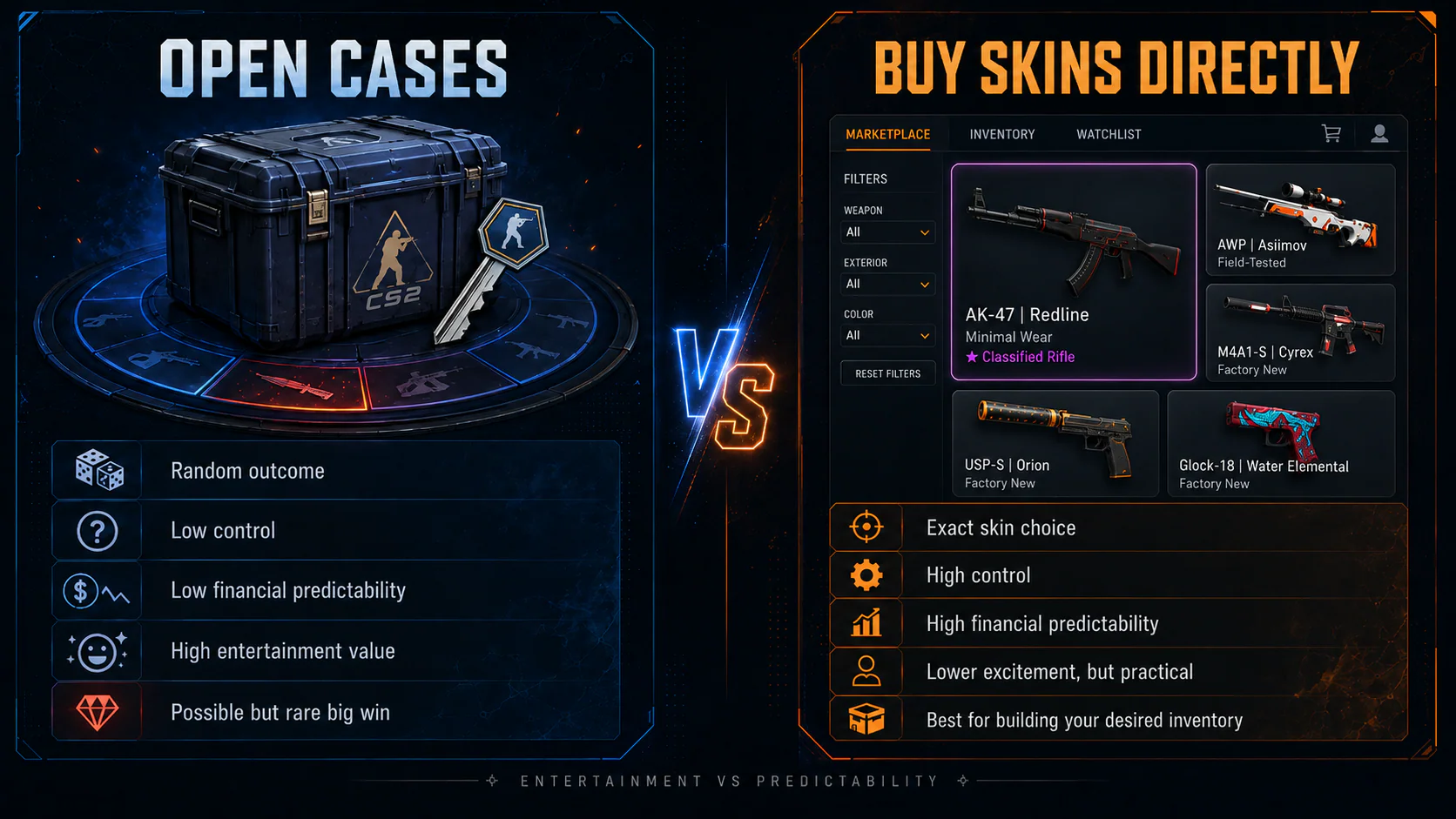
For most players who want a specific skin, buying directly is the more rational option. Opening cases is unpredictable, while buying a skin gives immediate control over weapon, finish, wear, price, and sometimes float or pattern.
Factor | Opening cases | Buying skins directly |
|---|---|---|
Control | Low - random outcome | High - choose exact skin |
Financial predictability | Low | High |
Entertainment value | High for some players | Lower, but practical |
Chance of a major upside | Possible but rare | No random upside |
Best use case | Entertainment budget | Building a desired inventory |
The practical recommendation is simple: open cases only with money you are comfortable spending for entertainment. If your goal is to own a specific AK-47, M4A1-S, AWP, knife, or glove skin, buying directly is usually the cleaner and safer path.
Final Verdict
CS2 case odds heavily favor common outcomes. The commonly accepted estimate is that Mil-Spec items account for approximately 79.92% of standard weapon case drops, while Rare Special items account for approximately 0.26%. That distribution explains why most openings do not return a valuable item and why knife unboxings are memorable precisely because they are so rare.
From an analytical perspective, case opening should be evaluated through probability and expected value. A case can contain high-value items and still be a poor financial decision on average. The rare outcomes create excitement, but the common outcomes dominate the distribution.
The best verdict is balanced: opening cases can be entertaining, but it should not be treated as a reliable investment strategy. For players who want specific skins, direct purchasing remains the more predictable option.
FAQ
What are CS2 case odds?
CS2 case odds are the approximate probabilities of receiving each rarity tier when opening a case. They describe rarity outcomes, not guaranteed profit.
What is the chance of getting a knife?
The commonly accepted estimate for a Rare Special item such as a knife or gloves is approximately 0.26%.
Are case odds the same for all cases?
Standard weapon cases are generally discussed using the same rarity-tier estimates, but the item pools differ by case. Different skins, finishes, and rare item pools can create very different market values.
Is opening cases profitable?
Usually, no. Most openings return lower-rarity items, and the average market value often does not exceed the cost of the case and key.
What is the safest way to get skins?
The safest way to get a specific skin is to buy it directly. Direct buying avoids random outcomes and gives control over price, wear, float, and item choice.
Does opening more cases guarantee a knife?
No. More openings create more attempts, but each opening is independent. There is no guaranteed knife after a fixed number of cases.
Can a lower-rarity skin be valuable?
Yes. Some lower-rarity skins can be valuable because of low float, trade-up demand, rare patterns, StatTrak status, or strong player demand.
The most useful conclusion for readers is not that cases are always bad or always exciting. The useful conclusion is that case opening should be treated as paid entertainment with a small chance of a high-value outcome. Buying skins directly is a purchase decision. Opening cases is a probability decision.
Even when a case appears to have a better EV than another case, that does not mean it is profitable. It may simply lose less on average. This difference matters. A case with a net EV of -$0.80 is analytically better than a case with a net EV of -$1.60, but both are still negative expectation if the costs and prices are accurate.
A strong EV calculation requires more than one headline number. It needs the average value for each possible drop, weighted by probability. In a simplified article, it is acceptable to use a hypothetical EV table as long as the example is clearly labeled. In a live market tool, the calculation should update item prices dynamically because one case can become more or less favorable as skin prices move.
Set a fixed entertainment budget before opening, not after losing.
Account for marketplace fees if you plan to sell the drop.
Do not use the price of the best knife as the expected result.
Remember that most outcomes are Mil-Spec or Restricted.
Review the current market prices of the main high-value items in the case.
Check the total opening cost, including the case price and key price.
Before opening a case, a player can use a simple checklist to understand the decision more clearly. This checklist does not remove randomness, but it prevents the most common analytical mistakes.
Written by
Team Chance4Skin


