
CS2 Case Item Pool Guide: How to Read Possible Drops Before Opening
Published: 04.07.2026
Many players judge CS2 cases by the most expensive skin shown in a case preview. A rare knife, gloves, or premium AK-47 or AWP skin can make a case look attractive, but the full CS2 case item pool matters more than one headline reward. Before opening any CS2 case, users should check possible drops, rarity tiers, drop chance, case price, expected value, EV ratio, and current market prices.
Reading the item pool does not guarantee a good result. CS2 case opening is random, and users cannot predict, control, or influence the drop. Still, checking the pool helps players understand what they are actually opening, compare cases more realistically, and decide whether opening a case makes sense compared with buying the target skin directly.
What Is a CS2 Case Item Pool and Why Does It Matter?
A CS2 case item pool is the complete list of possible drops inside a case. Depending on the case, it may include weapon skins, knives, gloves, StatTrak versions, or other special rewards.
Official CS2 cases usually have defined collections and rarity structures. Third-party CS2 case sites may use custom item pools grouped by weapon, rarity, theme, price range, or another category. Because item pool structures differ, users should review each case separately.
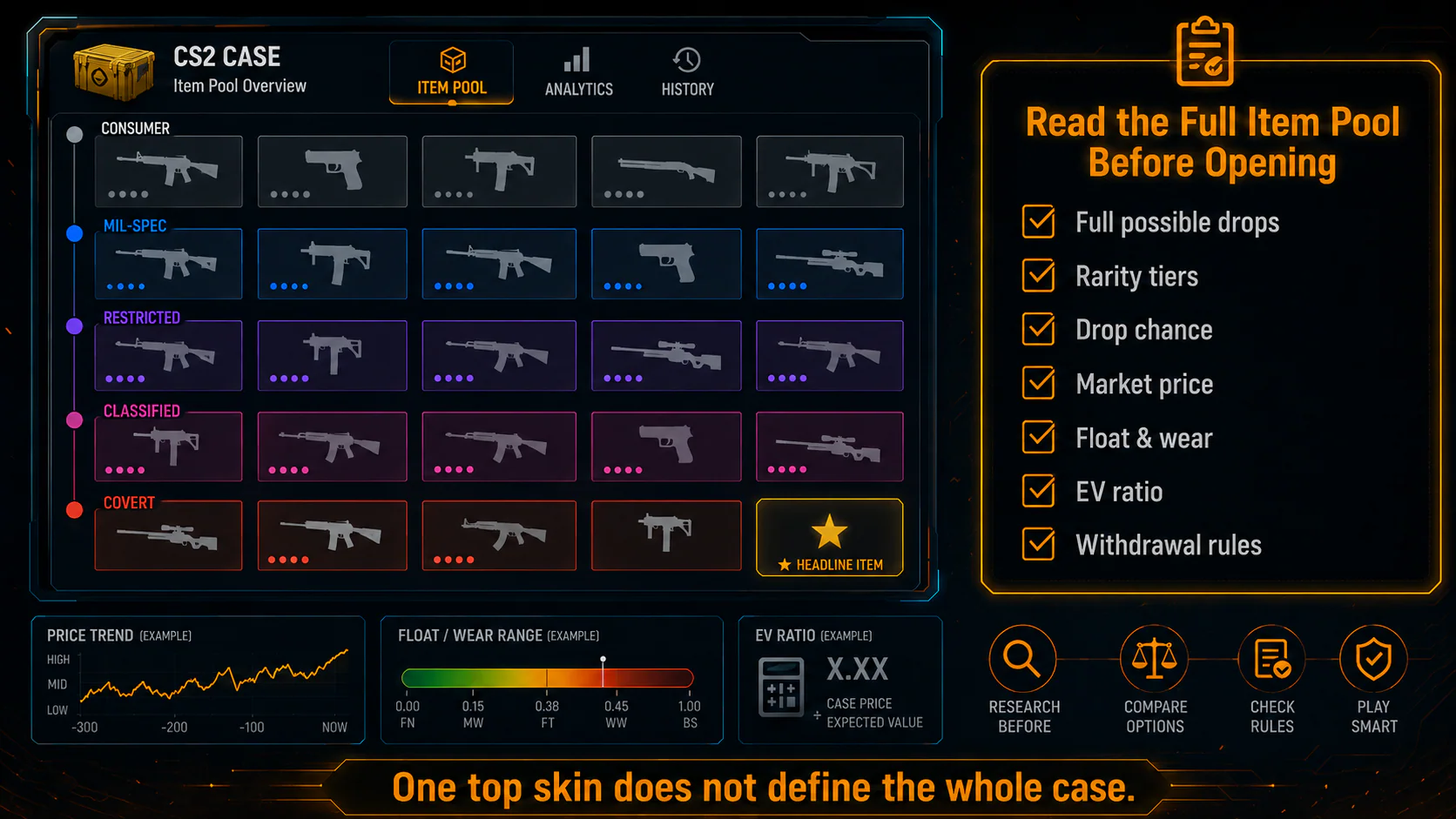
The most expensive reward does not define the whole case. A case can include one very valuable item while most outcomes are much lower in skin value. Item pool quality affects case comparison because users need to understand both the best possible drops and the more common results.
How to Read Possible Drops Before Opening a CS2 Case
Start by opening the case page and reviewing every possible drop, not only the featured skins at the top. Check whether the case shows all items clearly and whether the list includes lower-tier rewards.
Next, review rarity tiers. Rarity helps show which items are usually more common and which are usually harder to receive. Then look for drop chances or probabilities. If odds are shown by item or by rarity tier, compare them before opening.
After that, compare low-tier and high-tier rewards. The top item may be valuable, but low-value outcomes often make up many actual results. A case with weak lower-tier items can look better in the preview than it feels in practice.
Check current market prices for key items. Avoid relying on old screenshots or outdated examples because market price can change. If available, review float value, wear level, StatTrak, pattern, sticker, and special item details.
Finally, compare the case price with possible outcomes. If expected value or EV ratio is available, use it as an extra comparison point. On third-party CS2 case sites, also review withdrawal rules, limits, fees, and item availability before opening.
CS2 Case Item Pool, Rarity Tiers and Drop Chance
Rarity tiers and drop chance should be read together. Most cases follow a simple logic: common or lower-rarity items appear more often, while rare, premium, or special items usually have lower drop chances.
High-rarity rewards can make a case look attractive, especially when the preview shows knives, gloves, or expensive rifle skins. However, low-rarity rewards often make up most outcomes. This is why users should check the full CS2 case item pool instead of focusing only on rare items.
Rarity does not always equal high market value. A lower-rarity skin can have strong demand, while a higher-rarity skin may be less valuable because of wear, supply, appearance, or market interest. Drop chance explains the probability of receiving a specific item or rarity tier. Hidden odds are a trust concern, because users cannot properly compare cases without probability data.
Why Headline Rewards Can Be Misleading
Case previews often highlight the most expensive possible rewards, such as rare knives, gloves, premium AK skins, or AWP skins. These items may be real possible drops, but they may also have very low probability.
A case with one huge reward can still have weak overall value if many outcomes are low-value items. The headline skin may create attention, while the realistic outcome range is much less exciting. Low-value drops matter because they shape the usual result of opening the case.
Visual promotion should not replace probability data. Before opening, users should check the full item pool, drop chance, case price, and market value instead of judging a case by one featured item.
Case Price, Market Value, Expected Value and EV Ratio
Case opening cost is the first number to check. This may include the case price, key cost, platform cost, or any other required fee. Once the cost is clear, compare it with both low-value and high-value possible drops.
Market price is also important. CS2 skin prices can change because of demand, supply, updates, trends, and collector interest. A case that looked reasonable earlier may look different after prices move.
Expected value is a theoretical average item value based on possible drops and their probabilities. EV ratio compares expected value with the case price. These metrics can help users compare CS2 cases, but they do not guarantee individual results. A single opening can still produce a low-value item.
EV depends on accurate odds and current market prices. A cheap case is not automatically better if its item pool is weak. An expensive case is not automatically better if the cost is high compared with realistic outcomes.
Skin Details That Affect Value
Users should not judge a drop by skin name alone. Two versions of the same skin can have very different market prices.
Float value helps determine wear level. Common wear levels include Factory New, Minimal Wear, Field-Tested, Well-Worn, and Battle-Scarred. Cleaner wear can be more valuable, although demand varies by skin.
StatTrak availability can affect price because some users prefer tracked versions. Stickers may matter when they are rare, desirable, or placed well. Pattern can also influence value on certain skins. Rarity, float value, wear level, StatTrak, stickers, pattern, and current market price should all be checked together.
Official CS2 Cases vs Third-Party CS2 Case Sites
Official CS2 cases usually have defined collections connected to specific case releases. Users can review the included skins and compare them with current market prices.
Third-party CS2 case sites may create custom cases with custom item pools. These pools may group skins by weapon, theme, rarity, price, or platform category. Custom pools can be useful for browsing, but they can also be harder to compare.
Users should check odds and item pools separately on every platform. Similar-looking cases may have different probabilities, prices, or withdrawal conditions. On third-party sites, withdrawal rules may matter as much as the drop itself.
Common Mistakes and a Checklist Before Opening
Common beginner mistakes include focusing only on the most expensive skin, ignoring low-value outcomes, ignoring drop chance, ignoring case price, and not checking current market price. Some users assume rare items are likely because they appear in previews, or assume a case is good because it looks premium.
Other mistakes include not checking whether the target skin is actually in the case, ignoring withdrawal rules on third-party sites, and chasing losses after bad outcomes. CS2 case opening should be treated as random entertainment, not as a way to recover money or create income.
Before opening, check:
What items are in the case?
Is the full item pool visible?
Are drop chances shown?
What are the lowest-value possible drops?
What are the highest-value possible drops?
What is the case price?
What are the current market prices of key items?
Is EV or EV ratio available?
Are float value and wear levels relevant?
Is StatTrak possible?
Are there knives, gloves, or special items?
Are withdrawal rules clear if using a third-party case site?
Would buying the target skin directly be more predictable?
When a Case Item Pool Looks Strong or Weak
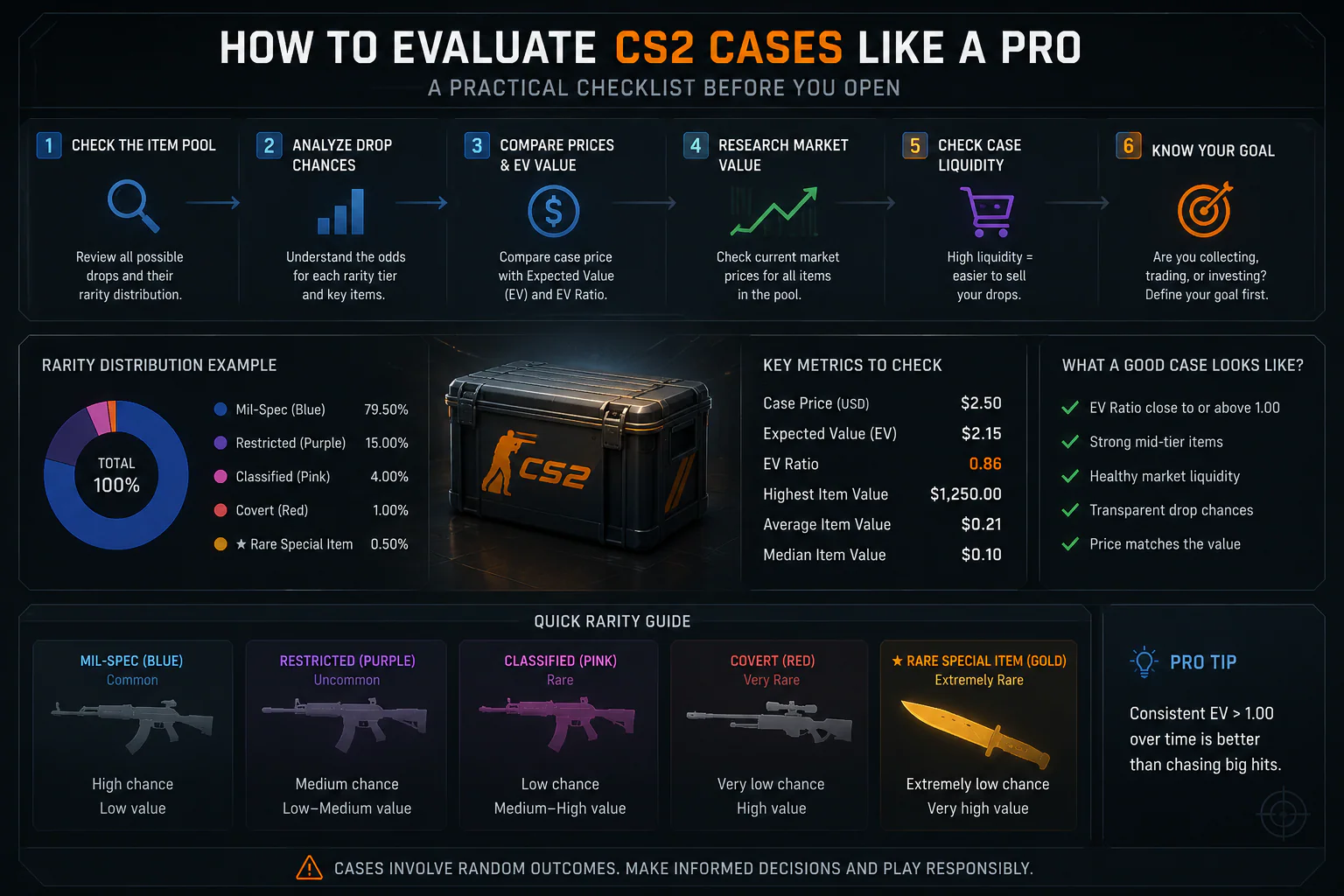
Strong signals include clear possible drops, visible odds, a balanced item pool, reasonable case price, transparent EV-related data, clear market value context, and realistic expectations about rare drops. For third-party sites, clear withdrawal rules are also important.
Weak signals include unclear possible drops, hidden odds, too much focus on one top reward, many low-value outcomes, weak EV-related data, confusing case price, unclear skin values, vague item pool descriptions, and aggressive promotion without transparent probabilities.
Buying Skins Directly vs Opening Cases
Buying skins directly gives certainty. Users can choose the exact skin, float value, wear level, StatTrak version, pattern, and stickers they want. This is usually more predictable for players who want one specific item.
Opening a case depends on random outcomes. A target skin may be in the item pool but still have a low drop chance. In some situations, repeated case opening can cost more than buying the skin directly. Before deciding, compare the item pool, odds, case price, and market price.
How Chance4Skin Can Help
Chance4Skin helps users explore CS2 skins, review possible drops, compare case odds, understand drop chances, check market context, and evaluate EV-related information. It works as a CS2 skin analytics and wiki-style platform for users who want clearer data before opening cases or buying skins.
Chance4Skin does not remove randomness or predict drops. It can, however, help users compare item pools, review skin value factors, and make more informed decisions based on case data rather than hype.
FAQ
What is a CS2 case item pool?
A CS2 case item pool is the full list of possible drops inside a case. It shows what users may receive if they open that case.
Why should I check possible drops before opening a case?
Possible drops help users understand what outcomes are available. Checking the item pool helps users avoid judging a case only by one expensive headline skin.
Does a better item pool mean better odds?
Not always. A case can include valuable skins, but those skins may have very low drop chances, so users should check both item pool and odds.
What is the most important thing to check in a case item pool?
Users should check full possible drops, drop chance, case price, market prices, and EV-related data if available. One expensive skin is not enough to evaluate a case.
Can I use an item pool to predict my drop?
No. Case opening is random. Reading the item pool helps users understand possible outcomes, but it does not predict or control the result.
Why do headline rewards mislead some users?
Headline rewards are often the most expensive possible drops, but they may have very low probability. Users should check the full item pool and odds before opening.
Is buying a skin directly better than opening cases?
Buying directly is usually more predictable if the user wants one exact skin, float value, wear level, or StatTrak version. Case opening depends on random drop chance.
Can Chance4Skin help compare case item pools?
Chance4Skin can help users review CS2 skins, possible drops, case odds, drop chances, market context, and EV-related information before opening cases.
Written by
Team Chance4Skin


