
CS2 Case Site Trust Score Explained: How to Evaluate Risk Before Depositing
Published: 04.07.2026
Many CS2 case sites look similar from the outside. They may use polished design, large skin images, animated case openings, leaderboards, promo codes, influencer graphics, and expensive headline rewards. For a beginner, these signals can feel persuasive, but they do not necessarily explain how the platform works behind the interface.
A modern layout does not prove that case odds are clear. A large bonus does not prove that withdrawals are simple. A promotion does not explain KYC, account verification, locked balances, bonus restrictions, drop chance, expected value, or the rules for receiving skins.
A CS2 case site trust score is a practical way to review those details before depositing money or skins. Instead of judging a site by design or hype, the framework scores visible trust signals across odds, withdrawals, KYC policy, bonus terms, company information, support, user reputation, and EV or RTP transparency.
A trust score does not make third-party CS2 case opening fully safe. It cannot predict drops, remove random outcomes, or prove that a platform will behave well in every situation. It can, however, help users compare CS2 case sites more systematically and identify missing information before value is committed.
What Is a CS2 Case Site Trust Score?
A CS2 case site trust score is a structured risk evaluation method. It breaks a platform into separate trust categories and assigns points based on information that users can see, read, and check before depositing.
The score is not a certificate of safety. Third-party CS2 case sites operate with their own terms, payment rules, withdrawal systems, verification policies, and promotional restrictions. Those rules may differ significantly from site to site and can affect the user experience as much as the case-opening result itself.
The main benefit is consistency. Instead of relying on subjective impressions, users can ask the same questions for every platform: Are the case odds visible? Is the item pool complete? Are withdrawal rules explained? Is KYC clear? Are bonus terms understandable? Does support respond? Are reviews showing repeated complaint patterns? Is EV or case value data transparent?
A score is especially useful before depositing because users have more control before they accept platform terms, use a promo code, or convert money or skins into site balance. Once funds are already inside a platform, unclear rules become harder to avoid.
Why Trust Scores Matter Before Depositing
Third-party CS2 case sites are separate from the official CS2 cases vs third-party case sites system. Each platform may set its own case prices, item pools, odds display, bonus rules, withdrawal limits, payment methods, account verification checks, and support process.
This creates risk because a user may understand CS2 skins but still miss platform-specific restrictions. For example, they may know what float value, wear level, StatTrak, and market price mean, but not realize that a bonus balance may be locked, that withdrawals may require a minimum amount, or that account verification may be requested before skin delivery.
Trust scores matter because many questions are easier to answer before depositing. Users can inspect case odds, read withdrawal terms, compare bonus restrictions, check legal pages, and test support. After a deposit, the user may already be subject to rules they did not understand.
Attractive case artwork does not prove fair probability. Expensive top rewards do not explain the real drop chance. A leaderboard does not prove that ordinary withdrawals are smooth. Checking trust before depositing helps users slow down and evaluate the platform as a system rather than reacting to marketing.
Trust Score vs Red Flags: What Is the Difference?
A red flags guide identifies warning signs. Examples include hidden odds, unclear withdrawals, aggressive profit-style language, missing legal pages, repeated complaints, or vague bonus rules. Red flags are useful because some issues deserve immediate caution.
A trust score organizes those signals into a broader evaluation. It recognizes that a site may have mixed signals. One platform may show clear odds but weak KYC information. Another may explain withdrawals well but have confusing promo code terms. A third may have useful support but limited EV transparency.
This matters because trust evaluation is rarely a simple yes-or-no decision. One weak signal does not always prove that a platform is unsafe, but several weak signals across important categories increase concern. A trust score helps users see the full pattern.
The score should be used as a decision-support tool, not an absolute verdict. It helps users compare visible information, note uncertainty, and avoid relying on design, bonuses, or popularity alone.
A Simple CS2 Case Site Trust Score Framework
The following 100-point model is an educational framework for reviewing CS2 cases data and CS2 case site safety signals. It is not an official certification, audit, legal opinion, financial recommendation, or platform rating.
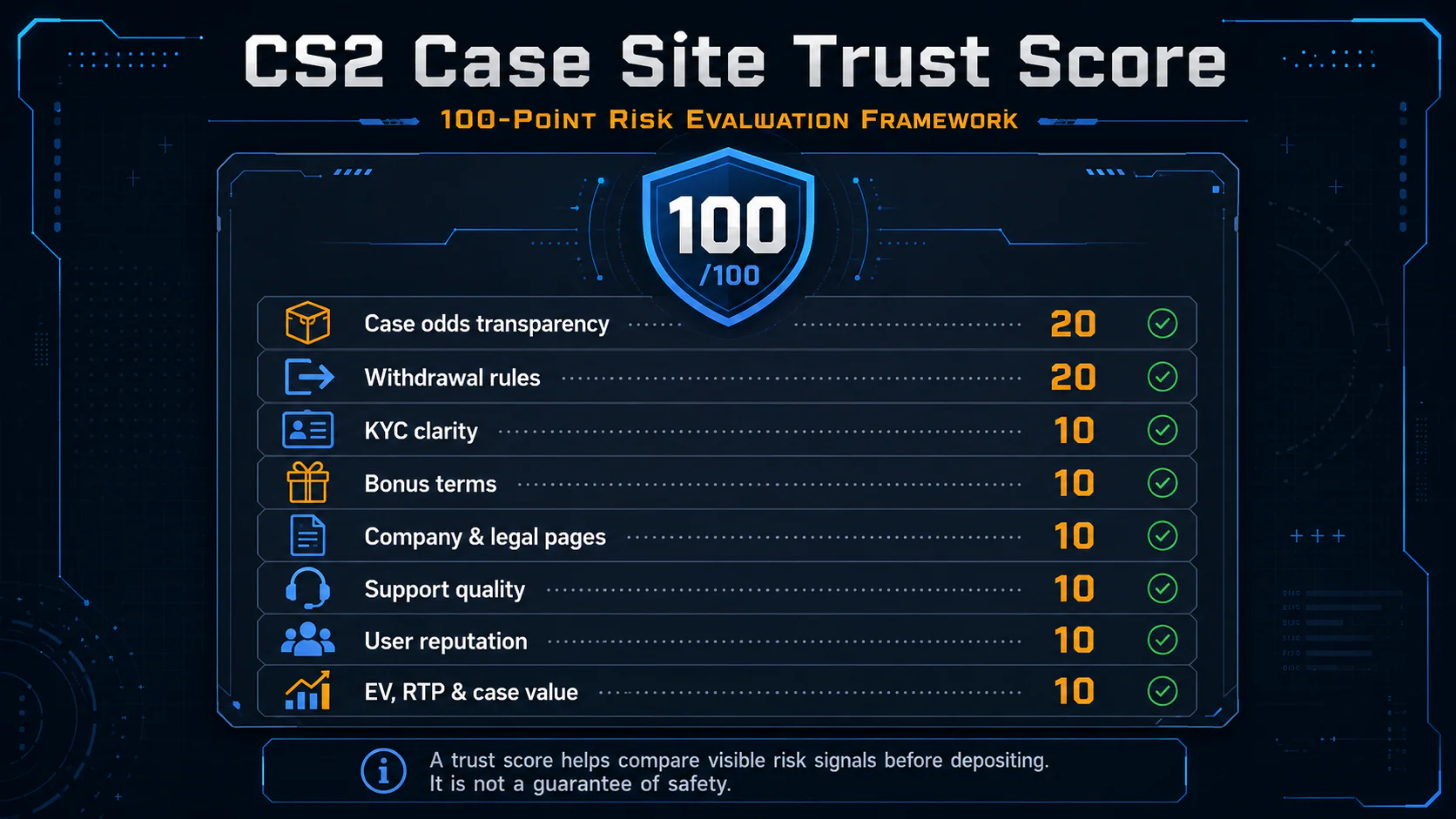
Users can adjust the weights depending on what matters most to them. Someone concerned about privacy may give more weight to KYC clarity. Someone comparing case value may care more about EV ratio and market price accuracy.
Even with adjustments, odds transparency and withdrawal clarity should usually remain high-priority factors. Without visible odds, users cannot properly evaluate drop chance. Without clear withdrawals, users cannot understand how value may be received, restricted, delayed, or converted.
Factor 1: Case Odds Transparency
Case odds transparency deserves a heavy weight because CS2 case opening depends on random outcomes. Users need to know the probability structure before opening, not after they have already spent balance.
A stronger platform should show the full item pool, drop chance for each item or rarity tier, and the probability of rare or premium skins. Odds should be easy to find and visible before the case is opened. Users should also check whether odds change by case, because one transparent case page does not prove that every case on the platform follows the same level of disclosure.
Hidden odds are a serious risk signal. If the user cannot see probability data, they cannot evaluate expected value, EV ratio, or how likely the headline rewards actually are. Case artwork and expensive top items are not replacements for odds.
Suggested scoring:
Score | Interpretation |
|---|---|
20/20 | Full odds and item pool clearly visible before opening |
10/20 | Partial odds or unclear item probability details |
0/20 | No clear odds or item pool shown |
Factor 2: Withdrawal Rules and Skin Delivery
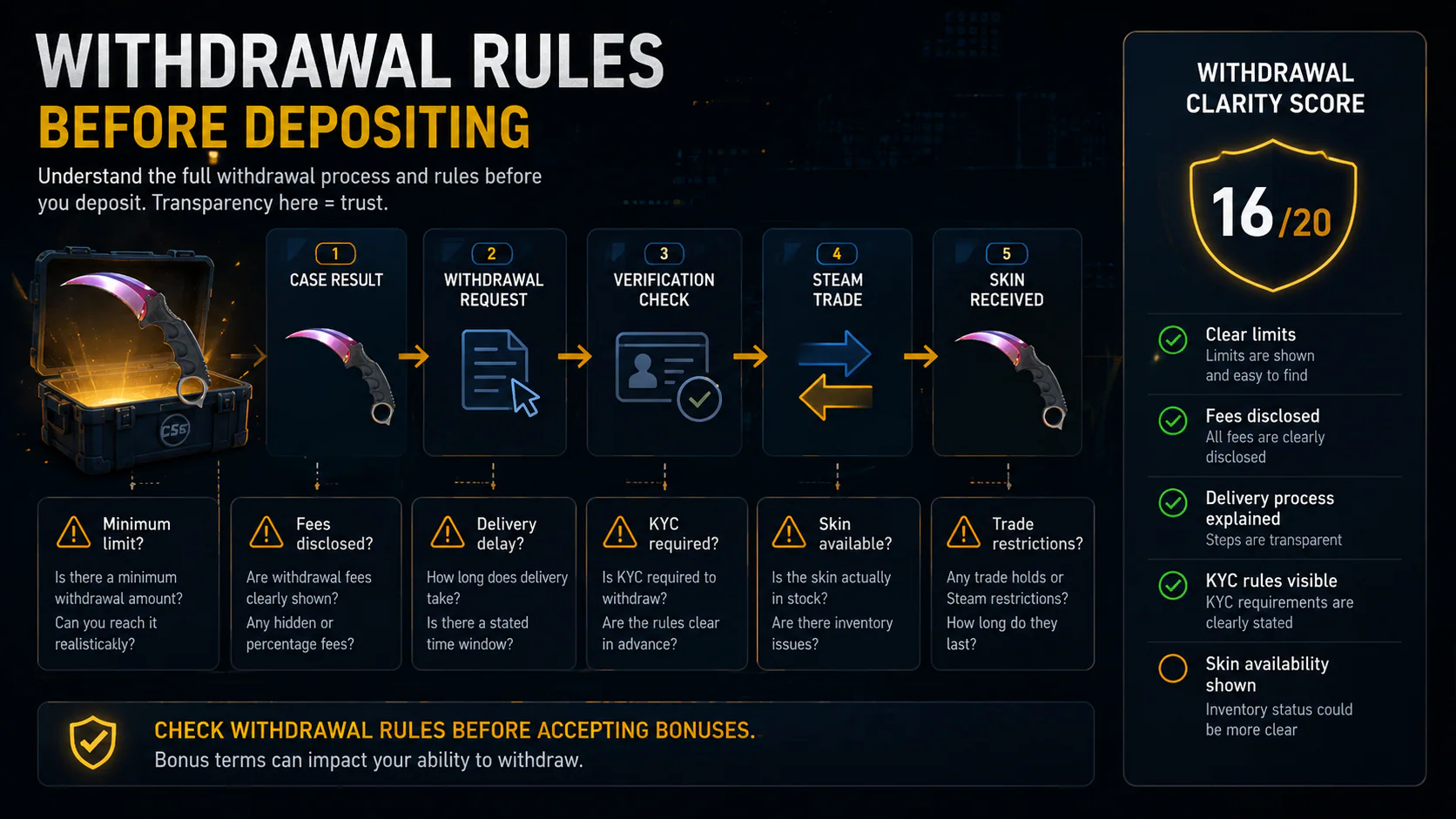
Withdrawal rules are one of the strongest trust factors because they determine whether users can receive value from the platform. The case result is only part of the experience; the next question is how skin delivery or balance withdrawal works.
Users should look for minimum withdrawal limits, fees, delays, skin availability rules, bot-based delivery details if applicable, Steam trade restrictions, locked balance explanations, cancellation rules, and whether the exact displayed skin can be withdrawn. Some platforms may offer replacement skins or site balance if an item is unavailable, so the terms should be clear.
Unclear withdrawal rules can create major frustration. A user may believe they received a withdrawable item but later discover limits, verification checks, unavailable inventory, bonus restrictions, or delays.
Suggested scoring:
Score | Interpretation |
|---|---|
20/20 | Clear withdrawal rules, limits, fees, and delivery process |
10/20 | Withdrawal rules exist but are hard to understand |
0/20 | Withdrawal process is vague, hidden, or heavily restricted |
Factor 3: KYC and Account Verification Clarity
KYC means “Know Your Customer.” On CS2 case sites, it usually refers to account verification where a platform may request identity information or documents. Platforms may connect KYC to payments, fraud prevention, account security, regulatory requirements, chargeback prevention, or withdrawals.
KYC is not automatically negative. The trust question is whether verification rules are explained before users deposit or try to withdraw. Users should know when KYC may be requested, what documents may be involved, and whether verification is connected to certain payment methods, withdrawal amounts, account changes, or risk checks.
There are also privacy concerns. Uploading documents to any third-party platform requires caution. Users should read the Privacy Policy and should not try to bypass platform rules, because that can create account problems.
Suggested scoring:
Score | Interpretation |
|---|---|
10/10 | KYC rules are clearly explained before deposit or withdrawal |
5/10 | KYC is mentioned but not fully clear |
0/10 | Verification requirements are hidden or appear only after issues occur |
Factor 4: Bonus and Promo Code Terms
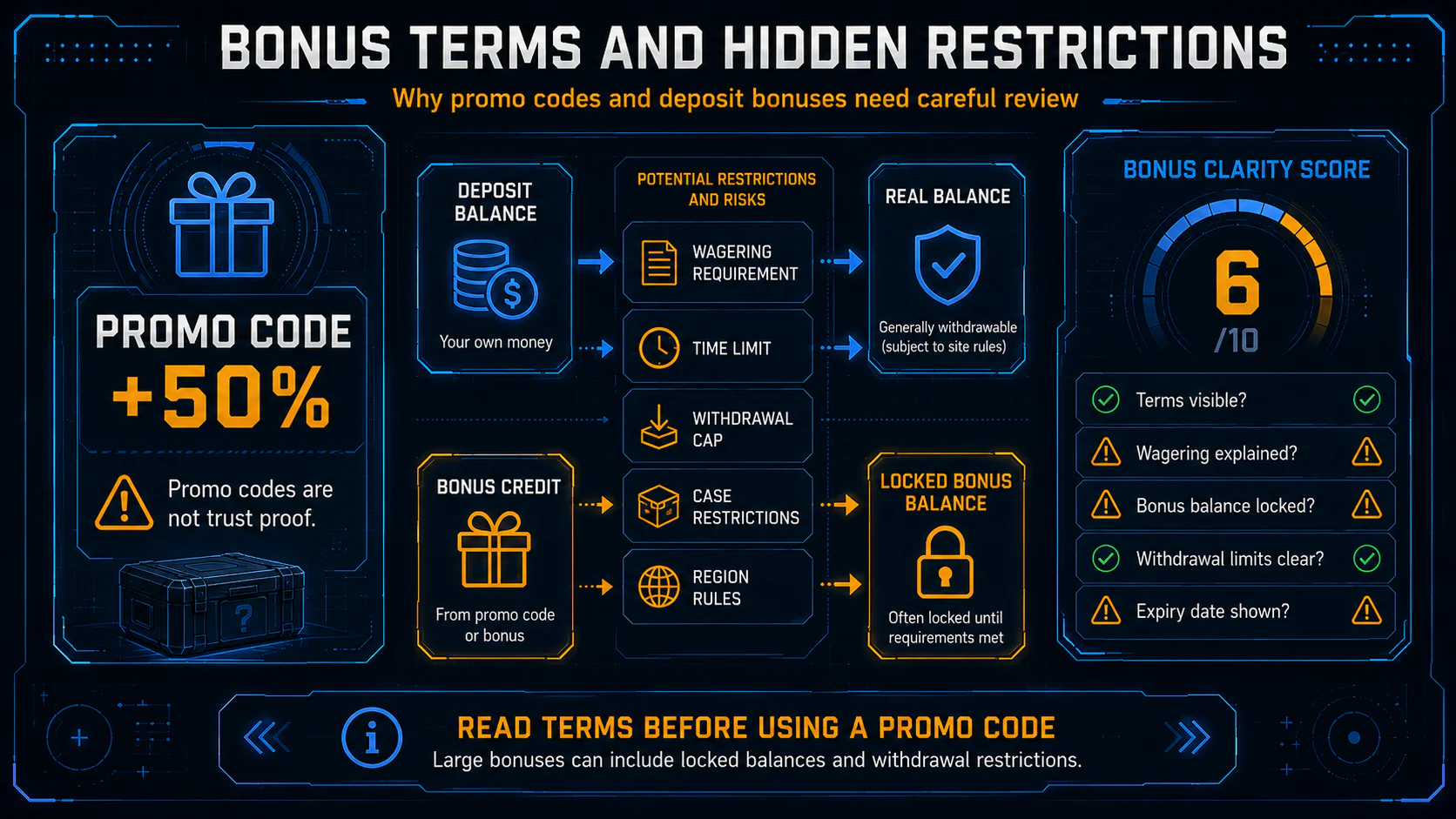
Bonuses can make a CS2 case site look attractive, but they are not strong trust signals by themselves. Deposit bonuses, promo codes, free cases, and limited offers may all come with restrictions.
Users should check wagering requirements, locked bonus balance, minimum deposits, maximum withdrawals, time limits, region restrictions, case restrictions, and the difference between real balance and bonus balance. A large bonus may be less useful if the terms are difficult to meet or if it limits withdrawals.
Clear bonus terms should be accessible before the user enters a promo code or accepts an offer. If a site heavily promotes bonuses but hides the rules, that should reduce the trust score.
Suggested scoring:
Score | Interpretation |
|---|---|
10/10 | Bonus rules are clear, accessible, and easy to understand |
5/10 | Bonus rules exist but are complex or incomplete |
0/10 | Bonuses are promoted heavily but terms are hidden or unclear |
Factor 5: Company Information and Legal Pages
Ownership and legal transparency help users understand who operates the platform and what rules apply. A professional-looking design is not the same as clear legal information.
Users should look for Terms of Service, Privacy Policy, payment terms, refund rules, dispute handling information, responsible use details, age restrictions, and any available company name, jurisdiction, or business information. Not every platform gives the same level of detail, but missing or vague legal pages create uncertainty.
Terms of Service may explain account restrictions, prohibited behavior, bonus limitations, verification requirements, withdrawals, refunds, and dispute processes. Privacy pages matter if the platform collects payment data, cookies, or KYC documents.
Suggested scoring:
Score | Interpretation |
|---|---|
10/10 | Legal pages and company details are visible and understandable |
5/10 | Basic legal pages exist but details are limited |
0/10 | Little or no clear legal information |
Factor 6: Support Quality and Response Channels
Support matters because problems can happen even when a platform looks organized. Payment issues, withdrawal delays, missing trades, account verification requests, locked balances, and bonus confusion all require help.
Users should check whether support is available through live chat, email, a ticket system, a help center, or social channels. The existence of a channel is not enough; the answers should be clear and relevant.
Before depositing significant value, users can test support with a simple question about withdrawal limits, KYC, promo code terms, or skin delivery. Repeated unresolved complaints about support should reduce the score, especially when they involve withdrawals or account access.
Suggested scoring:
Score | Interpretation |
|---|---|
10/10 | Clear support channels and reliable response signals |
5/10 | Support exists but quality or speed is unclear |
0/10 | No reliable support channel or repeated unresolved complaint patterns |
Factor 7: User Reviews and Reputation Signals
User reviews are useful only when read carefully. Users should not rely on one review source, one emotional comment, or influencer promotion. The goal is to look for repeated patterns across separate feedback.
Important patterns include withdrawal complaints, locked funds, hidden bonus terms, KYC disputes, unavailable skins, payment issues, and support not responding. Recent reviews usually matter more than old reviews because platforms can change policies, ownership, inventory systems, and payment providers.
Users should also watch for fake-looking reviews. Generic praise, repeated wording, sudden review bursts, or comments focused only on bonuses may not provide strong evidence. Community discussions can help, but they should still be compared with visible platform rules.
Suggested scoring:
Score | Interpretation |
|---|---|
10/10 | Generally consistent reputation with few serious recent complaint patterns |
5/10 | Mixed reputation or unclear review quality |
0/10 | Repeated serious complaints about withdrawals, locked funds, or hidden rules |
Factor 8: EV, RTP and Case Value Transparency
Expected value, or EV, estimates average theoretical value based on case odds and the market value of possible drops. EV ratio compares expected value with case price. RTP, if used by a platform, may describe value over many openings.
Expected value and EV ratio help users compare cases, but they do not predict individual outcomes. A user can still receive a low-value item from a case with reasonable theoretical value because each opening depends on drop chance.
EV also depends on accurate odds and current skin values. If item probabilities are hidden or market prices are outdated, the displayed value may be misleading. Users should consider case price, full item pool, wear levels, float value, StatTrak status, and realistic market value instead of focusing only on the most expensive possible drop.
Suggested scoring:
Score | Interpretation |
|---|---|
10/10 | EV, RTP, or case value data is clearly explained and based on visible odds |
5/10 | Some case value information exists but is incomplete |
0/10 | No useful case value transparency |
How to Calculate a Basic Trust Score
Review one platform at a time. Open its case pages, odds information, withdrawal terms, KYC policy, bonus rules, legal pages, support options, and recent reputation sources. Assign points for each factor based on what is visible and understandable.
Do not give full points for claims that cannot be verified. For example, a site says “fast withdrawals” but does not explain limits, fees, or delivery process should not receive the same withdrawal score as a site with detailed rules.
Write down missing information. Missing information is part of the risk evaluation because uncertainty affects the user experience. After scoring each factor, add the points together and interpret the range carefully.
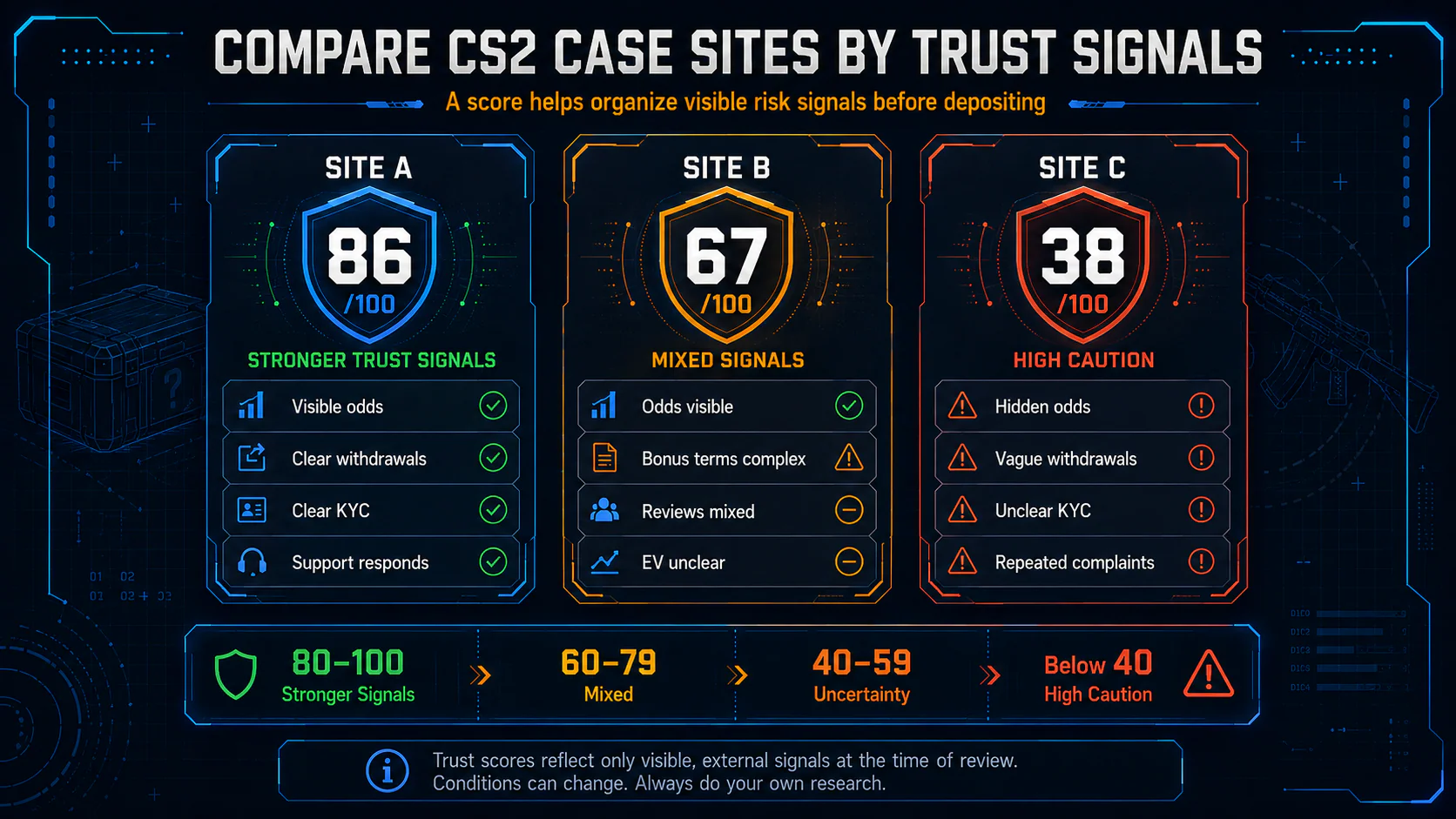
Score Range | Interpretation |
|---|---|
80-100 | Stronger trust signals, but still not risk-free |
60-79 | Mixed trust signals; review weak areas carefully |
40-59 | Significant uncertainty or missing information |
Below 40 | High caution; many trust signals are weak or unclear |
This framework is educational. It helps users compare visible information, but it does not prove safety or predict outcomes.
Example Trust Score Walkthrough
The following example uses a fictional platform called ExampleCaseSite. This does not apply to any real website and should not be interpreted as a review of any existing CS2 case site.
Factor | Maximum Points | Assigned Points | Reason |
|---|---|---|---|
Case odds transparency | 20 | 14 | Item pools and rarity odds are visible, but individual item probabilities are incomplete. |
Withdrawal rules and skin delivery | 20 | 12 | Withdrawal rules exist, but limits, delays, and skin availability need clearer explanation. |
KYC and account verification clarity | 10 | 5 | KYC is mentioned, but the exact verification triggers are not fully clear. |
Bonus and promo code terms | 10 | 6 | Promo code rules exist, but bonus balance restrictions are complex. |
Company information and legal pages | 10 | 6 | Legal pages are available, but company details are limited. |
Support quality and response channels | 10 | 7 | Live chat and email exist, but response reliability is hard to verify. |
User reviews and reputation signals | 10 | 5 | Reviews are mixed, including some withdrawal delay and bonus confusion complaints. |
EV, RTP, and case value transparency | 10 | 4 | Some case value information appears, but EV calculations are not clearly explained. |
Total score: 59/100
A score of 59 indicates significant uncertainty or missing information. ExampleCaseSite has some positive signals, such as visible item pools, support channels, and legal pages. However, weaker areas include incomplete odds, unclear withdrawal details, limited KYC clarity, and weak EV transparency. The score does not prove that the fictional site is unsafe; it simply shows that more caution and research would be appropriate.
High Trust Signals to Look For
High trust signals are visible, practical, and easy to check. Stronger platforms usually show case odds before opening, display full item pools, explain drop chance clearly, and make it possible to compare case odds instead of relying only on expensive headline rewards.
They also provide transparent withdrawal rules, including limits, fees, expected delays, delivery method, skin availability, and account verification requirements. Terms of Service, Privacy Policy, bonus terms, responsible use information, and age restrictions should be easy to find.
Other positive signals include realistic marketing language, responsive support, clear explanations of platform rules, and consistent recent user feedback with few serious unresolved complaints.
Medium Trust Signals: When More Research Is Needed
Medium trust signals appear when a platform provides some useful information but leaves important details unclear. Odds may be visible but not detailed enough. Withdrawals may be explained but missing specific limits. Bonus terms may exist but be difficult to understand.
Support may be available, but response quality may be uncertain. Legal pages may exist but be thin. Reviews may be mixed. EV data may be missing or shown without explaining how values are calculated.
A platform with medium signals requires extra caution. Users should identify weak categories, ask support direct questions where appropriate, and avoid treating incomplete information as confirmation.
Low Trust Signals and Serious Risk Indicators
CS2 case site red flags include no visible odds, hidden item pools, vague withdrawal rules, unclear bonus restrictions, hidden KYC requirements, missing legal pages, unclear ownership, no reliable support channel, and unrealistic reward messaging.
Repeated unresolved complaints are especially important when they involve withdrawals, locked balances, unavailable skins, payment issues, account verification, or support not responding. One complaint is not enough to judge a platform, but repeated recent patterns should affect the trust score.
Users should also be cautious of pressure to deposit more, aggressive profit-style claims, fake urgency, or locked balances without clear explanation. These signals do not prove that a specific site is a scam, but they increase uncertainty.
Why Design Quality Does Not Equal Trust
Good design can improve usability, but it does not prove fairness, reliability, or transparency. Modern interfaces, animations, influencer graphics, expensive skin images, bonus banners, and leaderboards can make a platform feel professional while leaving important rules unclear.
Users should not treat design as evidence of strong trust. Design does not explain case odds, withdrawal limits, KYC triggers, bonus restrictions, or EV calculations. It also does not prove that support will solve problems.
A trust score helps users move past appearance and review the platform’s rules, data, and reputation. A plain site with clear information may provide stronger trust signals than a polished site with vague terms.
Why Big Rewards Do Not Prove a Case Is Good
Expensive top rewards can create headline bias. A case may show a rare knife, gloves, or premium rifle skin, but rare CS2 skins drop chances do not reveal the probability of receiving that exact item unless the platform shows clear odds.
Users should review the full item pool, low-tier outcomes, case price, drop chance, expected value, and EV ratio. A case can look attractive while most outcomes are worth less than the case price.
The key question is not only "what is the best possible drop?" but "how does the full probability-weighted case structure work?" Without transparent odds and realistic skin values, users cannot evaluate case value properly.
Why Withdrawal Transparency Is Often More Important Than Bonuses
Bonuses may look appealing, but withdrawal transparency is usually more important. A promotion may add balance or offer extra openings, but withdrawal rules determine whether value can actually be received.
Bonus balance may not equal withdrawable balance. It may be restricted by wagering requirements, time limits, case limitations, region rules, or maximum withdrawal caps. Users should check withdrawal rules before accepting promotions.
A smaller offer with clear terms may be easier to understand than a large bonus with confusing restrictions. Platform trust should not be based on bonus size alone.
How Trust Score Helps Compare CS2 Case Sites
A trust score helps users compare CS2 case sites by applying the same factors to each platform. This makes weak categories easier to spot and reduces emotional decisions based on design, bonuses, or big rewards.
One site may score better on odds transparency. Another may score better on withdrawal clarity. A third may have useful support but weak EV data. The score helps users understand why platforms differ instead of treating all case sites as equal.
For beginners, the framework turns a vague question such as "is this site safe?" into specific review points. For intermediate users, it supports more consistent comparison of case odds, skin value, bonus terms, EV ratio, and platform rules.
Common Mistakes When Evaluating CS2 Case Sites
Common CS2 case opening mistakes include trusting a platform only because it looks popular, focusing only on promo codes, ignoring withdrawal rules, ignoring KYC, not reading Terms of Service, and judging cases by top rewards only.
Users also sometimes trust one review source without checking for broader patterns. Positive comments, influencer promotions, and screenshots of big wins do not replace odds transparency or withdrawal clarity.
Another serious mistake is chasing losses. CS2 case opening involves random outcomes. Depositing more to recover losses can lead to poor decisions. Case opening should not be treated as an investment strategy or a reliable way to obtain a specific skin.
Trust Score Checklist Before Depositing
Before depositing money or skins on a third-party CS2 case site, users can review this CS2 case opening checklist:
Are case odds visible before opening?
Is the full item pool shown?
Are withdrawal limits clearly explained?
Are withdrawal fees or delays disclosed?
Is KYC explained before deposit or withdrawal?
Are bonus and promo code terms clear?
Are Terms of Service and Privacy Policy easy to find?
Are support channels available?
Are recent reviews consistent?
Is EV or case value data available?
Does the site avoid unrealistic profit claims?
Would buying the target skin directly be more predictable?
This checklist does not remove risk. It helps users slow down and identify missing information before depositing.
When You Should Avoid Depositing
Users should step back when important information is missing. Hidden odds, unclear item pools, vague withdrawal rules, confusing bonus terms, missing KYC information, and unresponsive support are all reasons to pause.
Repeated serious complaints should also affect the decision, especially if they involve withdrawals, locked funds, hidden terms, or unresolved account problems. Users should avoid depositing if they do not understand the rules or cannot afford random outcomes.
Users should also avoid case opening when they are trying to recover losses. If the goal is one exact skin, float, wear level, or StatTrak version, buying CS2 skins directly is usually more predictable than relying on drop chance.
How Chance4Skin Can Help
Chance4Skin is a CS2 skin analytics and wiki-style platform that helps users understand skins, case data, and market context more clearly. It can support trust evaluation by helping users think beyond design and bonuses.
Users can explore CS2 skins, review skin value, compare case odds, understand drop chances, and think about EV-related information such as expected value and EV ratio. This context can make it easier to compare case-opening options and understand whether a case page provides enough useful information.
Chance4Skin can also help users identify trust-related signals on third-party CS2 case sites, including odds transparency, withdrawal clarity, case value explanations, and missing platform details. The goal is not to make case opening fully safe, but to help users evaluate uncertainty before depositing.
FAQ
What is a CS2 case site trust score?
A CS2 case site trust score is a structured way to evaluate risk signals such as odds, withdrawals, KYC, bonus terms, support, reviews, and EV transparency. It helps users compare visible information before depositing. It does not prove that a site is fully safe.
Can a trust score prove that a CS2 case site is legit?
No trust score can prove complete safety. It can only help users evaluate visible information and compare risk factors before depositing. A high score should be treated as stronger visible trust signals, not proof of future outcomes.
What is the most important trust factor for CS2 case sites?
Visible case odds and clear withdrawal rules are among the most important factors. Without odds, users cannot properly understand drop chance. Without withdrawal clarity, users cannot evaluate whether they can receive value from the platform.
Why do withdrawal rules matter so much?
Withdrawal rules determine how users may receive skins or balance from the platform. Limits, fees, delays, KYC, skin availability, and trade restrictions can all affect the experience. These details should be checked before depositing.
Are promo codes a trust signal?
Promo codes are not a strong trust signal by themselves. Users should read bonus terms, wagering requirements, locked balance rules, time limits, and withdrawal restrictions before accepting any promotion. A large bonus can still have restrictive terms.
How should I read CS2 case site reviews?
Look for repeated patterns across recent reviews instead of relying on one comment. Withdrawal complaints, hidden terms, support issues, and KYC disputes are more important than isolated emotional reactions. No review source should be trusted alone.
Does high EV mean a case site is trustworthy?
EV can help compare case value, but it does not prove that a platform is trustworthy. EV depends on accurate odds, current market prices, and transparent item pools. It also does not predict individual case-opening results.
Is a high trust score risk-free?
No case site is risk-free. A high trust score only suggests stronger visible trust signals. CS2 case opening still involves random outcomes, platform-specific rules, possible verification checks, and withdrawal uncertainty.
Should I use a CS2 case site if I want one exact skin?
Buying the skin directly is usually more predictable if the user wants one exact item, float, wear level, or StatTrak version. Case opening depends on drop chance. A case may not produce the specific skin the user wants.
Can Chance4Skin help evaluate CS2 case sites?
Chance4Skin can help users understand case odds, drop chances, skin values, EV-related data, and trust signals before making decisions. It can also help users compare case-opening options more clearly. This supports more systematic risk evaluation before using third-party CS2 case sites.
Written by
Team Chance4Skin


