
CS2 Stickers and Crafts Guide: How Stickers Affect Skin Value
Published: 12.07.2026
Stickers are among the most confusing value factors in the CS2 skin market. Two weapon skins with the same name and wear condition can have very different asking prices because one carries applied stickers with particular rarity, placement, history, or visual appeal.
The effect is rarely simple. Sticker rarity, the base skin, craft theme, team popularity, tournament history, sticker condition, scraping, wear condition, float value, visual compatibility, collector demand, and market liquidity may all influence how buyers view an item. Placement also matters because some sticker slots are more visible during normal gameplay, weapon inspection, or screenshots.
Most importantly, an expensive sticker does not automatically add its full standalone market price after it has been applied. The buyer is evaluating the complete skin-and-sticker combination, not purchasing a separate sticker that can later be removed and resold.
This guide explains how CS2 stickers and crafts may affect skin value, what sticker overpay means, why placement matters, and how beginners can evaluate unusual crafts without relying on misleading arithmetic or ambitious seller claims.
What Are Stickers in CS2?
Stickers are cosmetic items that can be applied to compatible CS2 weapon skins. They change the appearance of the weapon but do not affect gameplay performance, damage, accuracy, or other competitive characteristics.
CS2 stickers may come from tournament capsules, team collections, player autograph capsules, special events, themed releases, or other sticker collections. Versions may use finishes such as paper, holographic, foil, glitter, or gold.
An unapplied sticker remains a separate inventory item. It can be traded or sold independently, subject to the rules and restrictions of the marketplace being used.
Once the sticker is applied to a weapon skin, it becomes permanently associated with that specific item. It cannot be removed and restored to its original unapplied form. Scraping can alter or remove parts of the visible design, but it does not return the original sticker to the owner’s inventory.
Applied stickers can make a weapon more distinctive, personal, or collectible. They do not, however, guarantee a higher resale value. Some buyers may appreciate a particular design, while others may prefer the same skin without stickers.
This creates a distinction between objective item properties and subjective preferences. Objective properties include the exact skin, wear category, float value, sticker identity, placement, and scraping condition. Visual appeal, theme quality, and personal relevance are more subjective and can vary considerably between buyers.
What Is a Sticker Craft?
A sticker craft is a sticker-compatible weapon skin with one or more applied stickers. The term “craft” refers to the complete combination rather than the stickers alone.
Crafts can be simple, themed, humorous, team-based, tournament-focused, color-matched, or designed for collectors. A weapon may carry one prominent sticker, four matching stickers, four different stickers, or a mixed set selected to create a particular visual effect.
Crafts may be created for personal enjoyment or collector interest. A craft can be visually appealing without being expensive, or rare without being easy to sell.
The value of a craft may depend on:
the base weapon skin;
sticker selection and rarity;
sticker placement;
sticker condition;
the number of applied stickers;
color and theme compatibility;
skin wear and float;
collector demand;
Not every craft receives meaningful sticker overpay; personal appeal may not translate into wider demand.
“Craft quality” describes the complete visual and market result. It does not simply mean that the applied stickers had a high total standalone cost. A coherent, well-positioned craft on a suitable skin may attract more interest than a more expensive but visually weak combination.
Unapplied Sticker Value vs. Applied Sticker Value
Unapplied and applied stickers must be valued differently.
An unapplied sticker price is the market value of a sticker that remains a separate, tradable inventory item. Buyers of the unapplied sticker can keep it, trade it, resell it, or apply it to a skin of their choice.
An applied sticker contribution is the potential additional appeal created after that sticker has been permanently attached to a particular weapon skin. This contribution is not a separate asset. It exists only as part of the complete craft.
Several related terms should remain distinct:
Base skin value: the approximate value of the weapon skin before considering sticker overpay.
Unapplied sticker price: the value of the separate, tradable sticker.
Applied sticker contribution: the possible additional appeal created by the sticker on the exact skin.
Sticker overpay: the additional amount a buyer may pay above the base skin value.
Total craft value: a realistic estimate for the complete skin-and-sticker combination.
Listing price: the seller’s requested amount.
Completed sale value: the amount paid in a verified or otherwise reliable completed transaction.
An unapplied sticker offers flexibility because it can be traded, resold, or applied elsewhere. That flexibility is lost after application.
For that reason, the following calculation is misleading:
skin price + unapplied sticker price = craft value
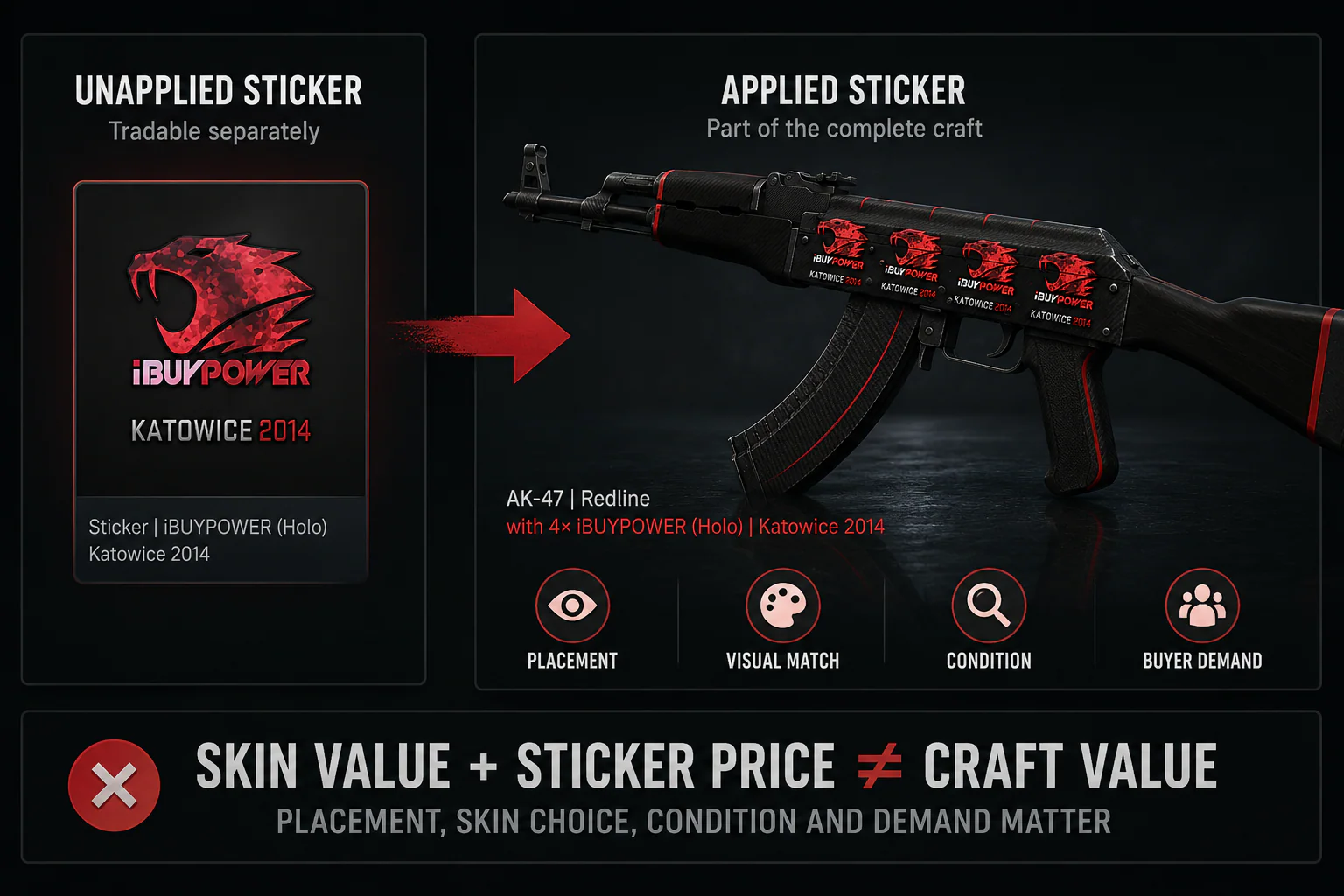
It treats the applied sticker as though it were still a separate tradable item. It also ignores placement, skin compatibility, visual quality, sticker condition, and buyer demand for the exact combination.
Consider a hypothetical example. A weapon skin has an identifiable base value, and a comparatively expensive sticker is applied in a clearly visible position. The sticker may increase collector interest, particularly if the colors and theme suit the skin.
That does not mean the total craft value automatically equals the base skin value plus the sticker’s unapplied price. A buyer is receiving one combined item with an irreversible application. The realistic price depends on whether buyers actually want that sticker on that skin, in that position, and in its current condition.
The same sticker can contribute differently across weapons, skins, and positions.
Even a visually strong craft has no guaranteed overpay. Market value can change, and some unusual combinations may not have enough comparable sales to support precise pricing.
What Is Sticker Overpay?
Sticker overpay is the additional amount a buyer may be willing to pay above the approximate base skin value because of the applied stickers.
Compared with a clean version, a stickered skin may attract small, moderate, significant, or no additional overpay.
Applied stickers may justify overpay when they improve one or more of the following:
visual appeal;
perceived rarity;
historical relevance;
team or player significance;
thematic consistency;
personal relevance to a collector.
Rare stickers, prominent placement, matching colors, a desirable base skin, clean sticker condition, and a coherent theme may increase buyer interest. Poor placement, scraped stickers, weak visual balance, low-demand skins, or an incoherent combination may reduce it.
Sticker overpay is not fixed and varies between buyers.
It is also useful to distinguish several types of overpay:
Seller-requested overpay: the premium included in the seller’s asking price.
Comparable listing overpay: the premium requested for similar active listings.
Completed-sale overpay: the premium demonstrated by an actual completed transaction.
Personal collector overpay: an amount one specific buyer is willing to pay because the craft has unusual personal relevance.
Seller-requested overpay is not proof of market value. Comparable listings can provide context, but listings may remain unsold because they are priced above current demand.
Completed sales or accepted offers generally provide stronger evidence, especially when the items are genuinely comparable. Even then, one unusual sale should not automatically define the value of every similar craft.
Why Sticker Placement Matters
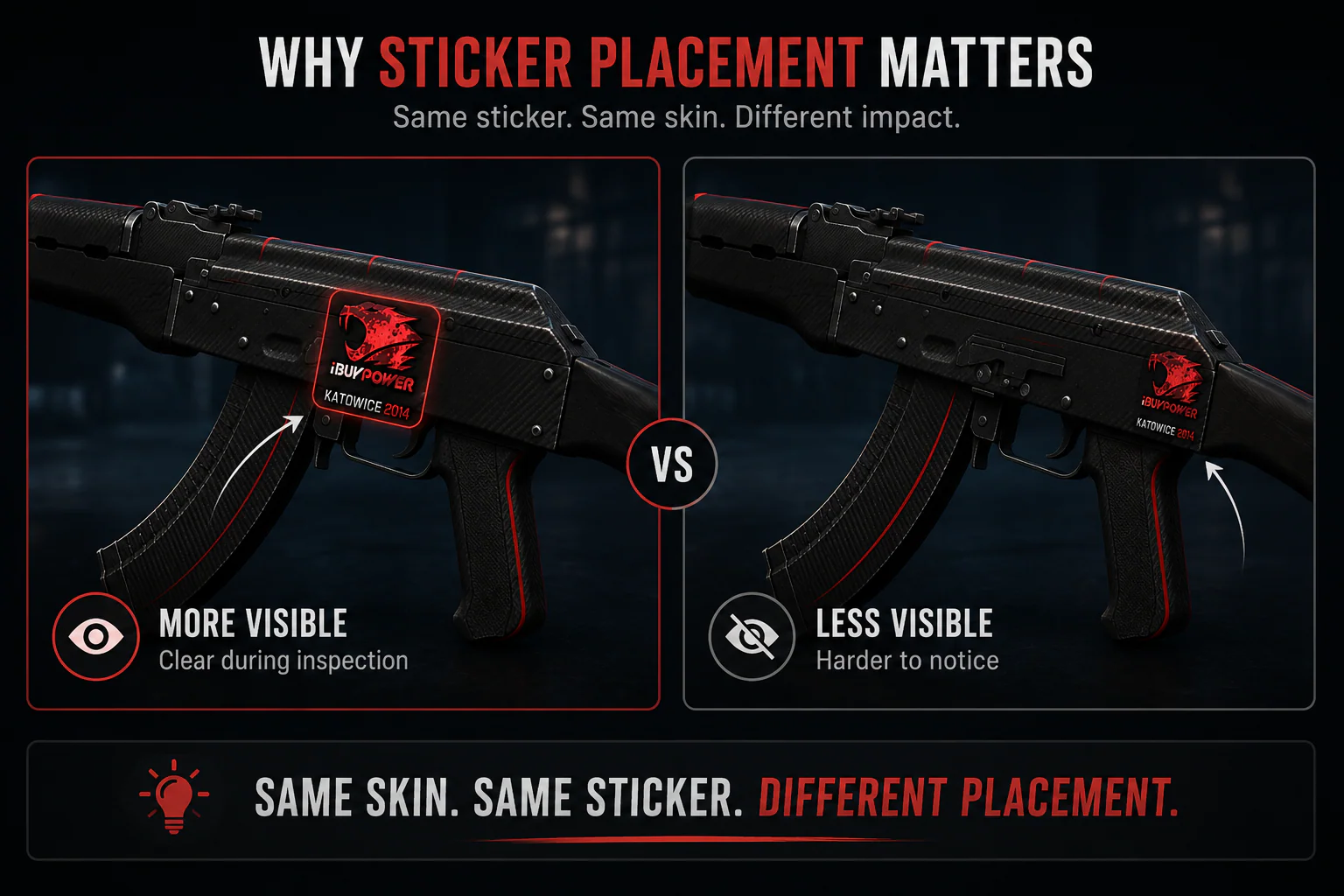
Sticker positions vary by weapon model. A slot that appears prominent on one weapon may be less visible on another, so there is no universal best sticker position for every CS2 skin.
Positions differ in gameplay, inspection, and screenshot visibility. A slot may also complement or obstruct important skin artwork.
A rare sticker in a hidden or awkward position may receive less overpay than the same sticker in a preferred position. Conversely, a less expensive sticker can improve a craft when it occupies a visually strong slot and complements the skin.
Placement matters differently for common craft formats:
Single-sticker crafts often depend heavily on whether the sticker is in a showcase position.
Four-sticker crafts must be judged as a complete layout.
Mixed crafts depend on balance, spacing, and the relationship between each slot.
Team or tournament crafts may look more coherent when the placement creates a clear pattern.
Buyers should inspect the actual weapon model rather than relying only on inventory text. The sticker list can confirm what is applied, but it does not show how visible, aligned, or visually compatible the application is.
A useful CS2 sticker placement guide must therefore consider the specific weapon, the geometry of each sticker slot, and how the craft looks in-game. Placement should always be checked visually before estimating craft value.
Sticker Rarity and Historical Demand
Sticker rarity can affect collector interest, but rarity alone does not guarantee strong applied value.
Older stickers may have a more limited remaining supply than recently released items. Tournament stickers can carry historical or nostalgic appeal, while team stickers may attract supporters of a particular organization. Autograph stickers may interest fans of a specific player.
Some sticker names have long-standing recognition within the collector market. Examples include Katowice 2014 stickers, Katowice 2015 stickers, Crown Foil, Howling Dawn, Titan stickers, and iBUYPOWER stickers. Popular team stickers and player autographs can also receive attention when their designs, history, or fanbases remain relevant.
These names should not be treated as automatic valuation shortcuts. A Titan sticker or iBUYPOWER sticker may be widely recognized, but the value of the applied craft still depends on the exact skin, placement, sticker condition, visual quality, and buyer demand.
Katowice 2014 stickers are particularly well known, but not every skin carrying one is equally rare, desirable, or liquid. A poorly positioned application on an unpopular skin may be difficult to price or sell despite the sticker’s reputation.
Historical demand may reflect design, tournament significance, team or player popularity, collector recognition, and compatibility with popular skins.
Demand can also change. Team popularity, player relevance, collector preferences, and the number of interested buyers are not permanent.
The commercial importance of rarity depends on whether buyers care about the exact craft. A rare sticker on a visually incompatible or low-demand skin may remain illiquid even when the sticker itself has a high unapplied price.
Skin Choice: Why the Base Skin Matters
The base skin is a major part of total craft value. Stickers do not replace the underlying demand for the weapon and skin.
Popular weapon categories such as the AK-47, AWP, M4A1-S, M4A4, USP-S, Glock-18, and Desert Eagle can have active craft audiences. Other sticker-compatible weapon skins may appeal to smaller groups. Demand still depends on the exact design rather than the weapon name alone.
Several base-skin characteristics matter:
Skin popularity: Well-known skins may attract more buyers, although demand is not guaranteed.
Skin rarity: The item’s rarity tier may influence its base value and collector profile.
Design: Artwork determines whether stickers complement or obstruct the skin.
Wear condition: Exterior condition affects appearance and base skin value.
Float value: Float provides a more precise measure of wear within the exterior category.
Color compatibility: Sticker colors may blend with or contrast against the artwork.
Sticker visibility: Weapon geometry affects how clearly each application can be seen.
Liquidity: Frequently traded skins are generally easier to compare than obscure items.
Two crafts using the same sticker can have very different demand when applied to different skins. A recognized sticker on a popular and visually compatible skin may attract more attention than the same sticker on a skin with limited demand or poor placement options.
Estimate the base skin value before adding any possible sticker overpay.
Color Matching and Craft Theme
Visual design can influence how buyers respond to a sticker craft.
Color-matched crafts often look deliberate because the sticker palette supports the skin artwork. Contrasting colors can also work when the contrast is balanced and the stickers remain readable.
Common craft themes include:
team-based combinations;
tournament sets;
player autograph collections;
four-of-a-kind layouts;
humorous or meme crafts;
mixed designs built around a shared color, symbol, or idea.
Team-themed crafts may appeal to supporters of a particular organization. Tournament crafts can attract collectors interested in an event or competitive era. Autograph crafts may be relevant to fans of an individual player.
Meme and mixed crafts may work visually but often have narrow demand or few direct comparables.
Sticker shape, color, placement, skin artwork, and spacing should be judged together. A coherent theme can increase buyer interest, but visual preference remains subjective.
A visually strong craft may sometimes attract more demand than a technically expensive combination with poor balance. This does not mean any specific color scheme universally adds value. The complete result and the available buyer pool remain decisive.
Wear, Float, and Sticker Crafts
Wear condition affects both the appearance and base value of a weapon skin. CS2 exterior categories include Factory New, Minimal Wear, Field-Tested, Well-Worn, and Battle-Scarred.
Float value is a more precise numerical measure of wear within the permitted range for the skin. Two items in the same wear condition can therefore look different or carry different market interest.
Cleaner surfaces may display some crafts more clearly. Scratches, darkened areas, or worn sections on the base skin can change the way the stickers interact with the artwork.
Lower float is not always visually preferable; some collectors may favor a worn appearance.
A low float does not automatically make every sticker craft valuable. A high float does not automatically make every craft undesirable. The effect depends on the base skin, its normal wear pattern, sticker placement, and the expectations of likely buyers.
Where relevant, pattern variation or uneven wear distribution can also affect visual compatibility. Anyone evaluating an expensive or unusual craft should inspect the exact item rather than relying only on the exterior label.
Sticker Condition and Scraping
CS2 stickers can be scraped, changing their visible appearance. Repeated scraping may remove portions of the design and can eventually make the sticker nearly invisible.
A scraped sticker is not equivalent to a clean, unapplied sticker. It is also not equivalent to the same sticker applied without scraping.
Scraping can affect collector interest because buyers may prefer a complete design. Rare scraped stickers should not automatically receive the same overpay as clean applications.
Some crafts use partial scraping intentionally. Removing a border, word, or background element can create a specific visual effect. An intentional scraped craft may be creative, but the intention alone does not guarantee market demand or overpay.
Buyers should inspect sticker condition directly and check whether each application is:
clean;
lightly scraped;
partially altered;
heavily scraped;
nearly removed.
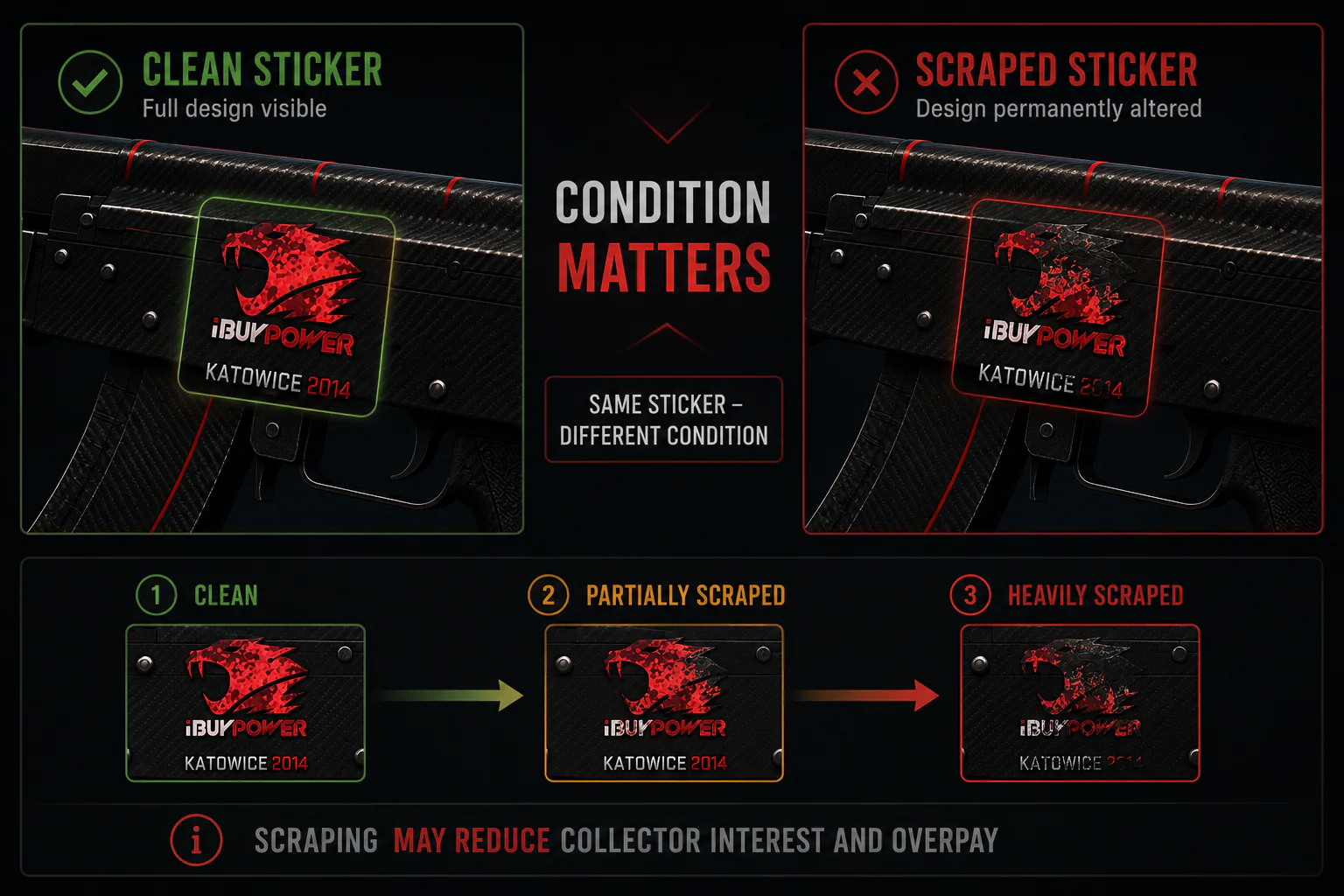
Confirm sticker condition through direct inspection rather than seller descriptions alone.
Scraping should be treated as a potentially permanent, value-affecting action. Users should verify the current CS2 sticker mechanics before making irreversible changes, particularly when historically recognized or expensive stickers are involved.
One Expensive Sticker vs. Four Matching Stickers
Different craft formats appeal to different buyers. The number of stickers is not a reliable shortcut for estimating value.
A single-sticker showcase craft places one notable sticker in a prominent position. Its appeal may depend strongly on placement, visibility, and the relationship between the sticker and base skin.
A four-of-a-kind craft uses four matching stickers. This can create consistency, symmetry, and a clear visual identity. Four inexpensive stickers do not automatically create meaningful overpay, however, and an expensive four-sticker combination can still be commercially illiquid.
A mixed thematic craft uses different stickers connected by a team, tournament, color, player, or visual idea. Strong mixed crafts can look intentional, but they may be difficult to compare with recent sales.
A random sticker combination may contain individually interesting stickers without a coherent theme. Some buyers may still enjoy it, but unrelated stickers can reduce visual balance and narrow the buyer pool.
Neither one rare sticker nor four matching stickers guarantees demand.
Craft quality depends on the full visual result, the base skin, placement, sticker condition, rarity, and liquidity—not simply the number or original cost of the stickers.
How CS2 Stickers and Crafts Affect Liquidity
Liquidity describes how easily an item can be sold or traded near a realistic market price.
Standard popular skins are often easier to compare because buyers can review many similar listings and completed sales. Unusual sticker crafts may have fewer direct comparables and may require a buyer who specifically wants that combination.
This creates several different situations:
A valuable and liquid item has demonstrated demand and can usually be priced using relevant market activity.
A valuable but illiquid item may justify overpay but require more time to find the right collector.
An expensive listing with no demonstrated demand has a high asking price but insufficient evidence that buyers accept it.
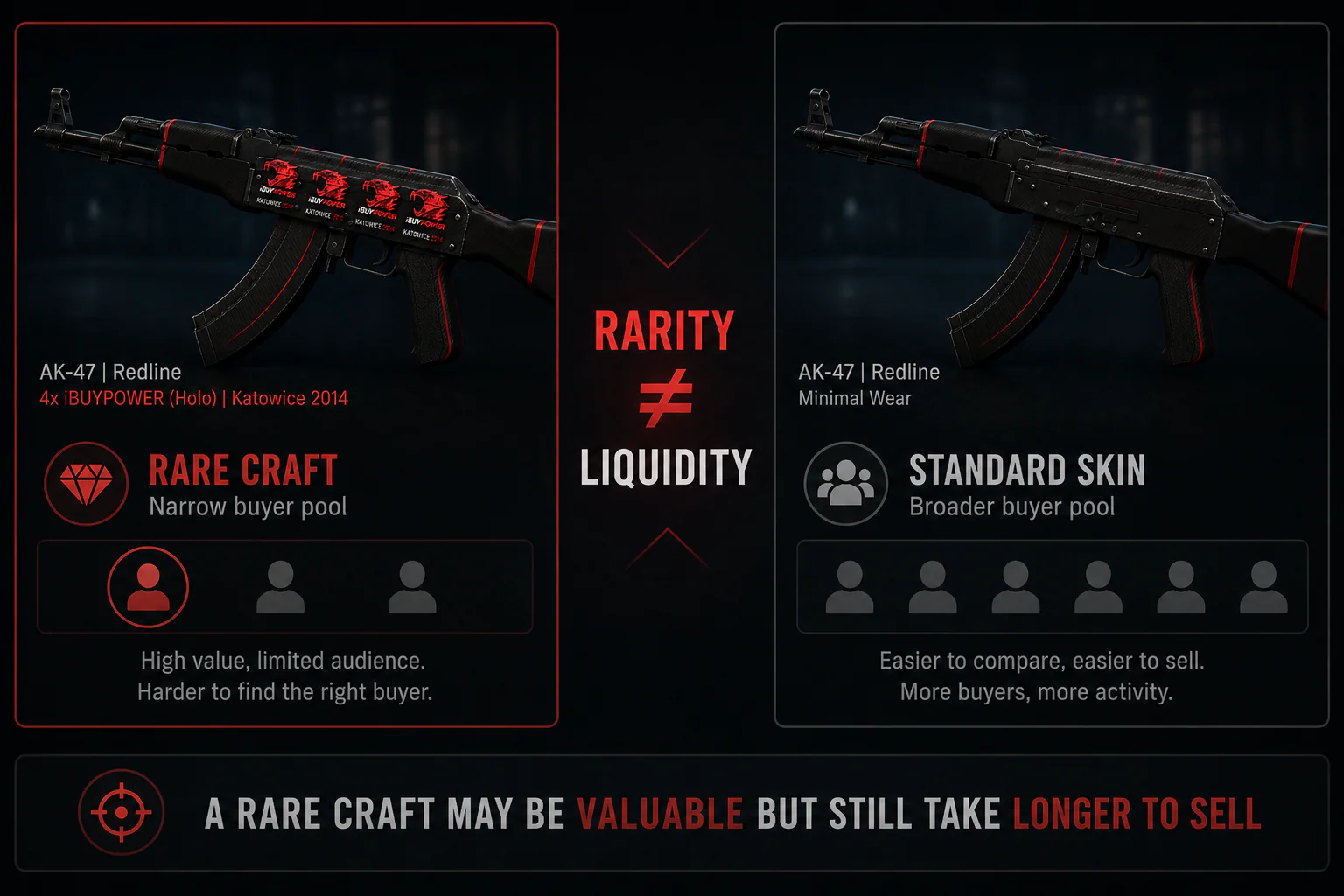
Rare CS2 stickers and crafts can be valuable while still having low market liquidity. Rarity measures how uncommon an item or combination is. Liquidity measures how easily it can be sold near a defensible value. The two should not be confused.
A unique craft may lack close completed sales, making pricing subjective and uncertain.
Realizing applied sticker overpay may take longer than selling a clean version of the same skin. Most general buyers may compare the item mainly with the base skin, while a smaller collector group may appreciate the stickers.
Users should therefore evaluate liquidity separately from rarity, technical sticker cost, and theoretical craft value.
Common Mistakes Beginners Make With Sticker Crafts
Sticker crafts are difficult to compare, so beginners often rely on shortcuts that produce unrealistic estimates.
Common mistakes include:
adding the full unapplied sticker price to the base skin value;
confusing unapplied sticker value with applied sticker overpay;
ignoring sticker placement;
buying based only on a famous sticker name;
overpaying for a visually weak craft;
overlooking the popularity of the base skin;
ignoring wear condition or float value;
assuming every old sticker is valuable;
assuming every Katowice sticker craft is highly desirable;
believing every four-sticker craft receives overpay;
overlooking sticker condition or scraping;
confusing rarity with market liquidity;
trusting seller screenshots without inspecting the exact item;
treating unsold listings as completed-sale evidence;
comparing unrelated crafts;
failing to compare the item with clean-skin alternatives;
assuming personal preference guarantees resale demand.
These errors often result from focusing on one attractive detail instead of the complete item. A famous sticker or its original price does not establish applied sticker value without suitable placement, condition, demand, and market evidence.
How to Estimate CS2 Sticker Craft Value More Carefully
There is no universal pricing formula, but a structured review can produce a more defensible estimate.
Step 1: Identify the Exact Base Skin
Record the weapon, skin name, exterior condition, and StatTrak status where relevant. Also check pattern variation or other special visual characteristics if they affect the item.
Start by estimating the base skin value without sticker overpay.
Step 2: Check Wear Condition and Float
Confirm the exterior category and float value. Consider how the exact wear affects the artwork, sticker visibility, and demand for the underlying skin.
Step 3: Identify Every Sticker
Record the precise sticker name, version, tournament, team, player, finish type, and number of copies applied. Do not assume that visually similar stickers are the same release.
Step 4: Inspect Sticker Condition
Check whether every sticker is clean, partially scraped, heavily scraped, or intentionally altered. Sticker condition can materially change visual appeal and collector interest.
Step 5: Review Sticker Placement
Inspect the exact slot occupied by each sticker. Consider visibility during gameplay, inspection, and screenshots rather than relying only on the inventory description.
Step 6: Evaluate the Complete Visual Result
Judge color matching, contrast, spacing, symmetry, readability, and theme. Review how the craft looks from normal in-game angles as well as in the inspection view.
Step 7: Assess the Base Skin’s Demand
Consider whether the skin is popular, visually compatible with stickers, actively traded, and commonly collected. A weak base skin can limit demand even when the sticker is rare.
Step 8: Identify the Craft Type
Determine whether the item is a single-sticker showcase, four-of-a-kind craft, team craft, tournament craft, autograph craft, mixed thematic craft, meme craft, or random combination.
Step 9: Find Relevant Comparables
Look for the same skin with the same sticker, similar placement, comparable wear and float, similar sticker condition, and the same general craft format.
Unrelated skins or placements are weak comparables, even when they use the same sticker.
Step 10: Separate Listings From Completed Sales
Give more weight to recent completed sales, accepted offers, and repeated market activity.
Give less weight to ambitious unsold listings, isolated screenshots without verifiable context, or unconfirmed seller claims. Listing price and completed sale value are not interchangeable.
Step 11: Check Current Buyer Demand
Consider the sticker’s popularity, team or player relevance, visual quality, collector recognition, and recent market activity. Demand can change, so older sales may not represent current conditions.
Step 12: Consider Liquidity
Estimate whether the craft appeals to a broad group, a narrow collector segment, or one highly specific buyer. Narrower demand generally makes precise pricing and quick resale more difficult.
Step 13: Estimate Overpay Conservatively
Do not apply one universal percentage to the unapplied sticker price. Applied sticker overpay depends on the exact skin, position, condition, theme, and current buyer demand.
Step 14: Compare With Direct Alternatives
Ask what the same budget could buy instead, such as:
a cleaner version of the skin;
a more liquid skin;
a better-positioned craft;
a visually stronger combination;
the unapplied sticker itself;
another item with clearer price discovery.
Step 15: State Uncertainty Clearly
When reliable comparables do not exist, state that the craft cannot be priced precisely. A range may still be uncertain, and invented precision can be more misleading than acknowledging limited data.
Step 16: Avoid Relying Only on Seller Claims
Inspect the exact item independently before buying or trading. Confirm the stickers, placement, wear, float, scraping condition, and relevant market evidence rather than relying solely on promotional screenshots or descriptions.
Sticker Craft Value Checklist
Factor | Why It Matters | What to Check |
|---|---|---|
Base skin | Establishes the starting value | Weapon, skin, exterior, StatTrak |
Skin popularity | Influences buyer demand | Trading activity and collector interest |
Wear condition | Affects appearance and base price | Exterior category and visible wear |
Float value | Refines the wear assessment | Exact float and wear distribution |
Sticker rarity | May increase collector interest | Release, version, and recognition |
Sticker placement | Changes visibility and appeal | Exact slot on the weapon |
Sticker condition | Scraping can reduce interest | Clean, partial, or heavy scraping |
Color matching | Affects visual coherence | Palette, contrast, and readability |
Four-sticker craft | Must work as a complete layout | Symmetry, repetition, and balance |
Team or tournament theme | May attract specific collectors | Historical and fan relevance |
Market liquidity | Affects ease of resale | Size and activity of buyer pool |
Realistic overpay | Separates stickers from base value | Defensible premium above clean skin |
Comparable listings | Provide asking-price context | Similar skin, stickers, and placement |
Completed sales | Show demonstrated buyer activity | Recent and genuinely comparable sales |
Direct buying alternative | Tests the value proposition | Clean skins and stronger competing crafts |
How Stickers Affect Case and Skin Decisions
Case drops may contain weapon skins with different base values, but sticker crafts are normally evaluated as exact individual items. Ordinary case opening generally produces skins rather than custom rare sticker combinations, unless a platform explicitly lists pre-crafted items as available outcomes.
A skin’s value can depend on details that are not visible from its name alone. When comparing exact items, users should inspect screenshots, sticker positions, wear condition, float value, sticker condition, and current market context.
Case opening is random and should not be treated as a reliable method for obtaining a particular valuable craft. The contents or probabilities of a case do not establish the value of an existing stickered skin.
A crafted item should therefore be evaluated separately from the general odds or contents of a case. Its realistic value depends on the exact base skin, applied stickers, placement, condition, visual result, and buyer demand.
How Chance4Skin Can Help
Chance4Skin provides educational information about CS2 skins, skin value factors, float and wear, sticker crafts, case-opening basics, item rarity, and case-site safety.
Understanding how stickers affect CS2 skin value can help users avoid confusing an unapplied sticker price with applied sticker overpay. It can also make it easier to recognize why two versions of the same skin may have very different asking prices.
By reviewing the base skin, sticker placement, wear, float, sticker condition, comparable listings, and completed sales separately, users can make more informed decisions and reduce the risk of overpaying for weak or difficult-to-price crafts.
Chance4Skin does not guarantee valuations or market outcomes; some crafts cannot be priced precisely without reliable comparables.
FAQ
Do stickers increase CS2 skin value?
Stickers may increase skin value or buyer interest, but not in every case. The result depends on sticker rarity, placement, base skin choice, sticker condition, craft quality, liquidity, and actual buyer demand.
Does an applied sticker add its full market price to a skin?
Usually, it does not. Once applied, the sticker becomes part of the complete craft and can no longer be traded as a separate unapplied item.
What is sticker overpay in CS2?
Sticker overpay is the additional amount a buyer may pay above the approximate base skin value because of the applied stickers. It is not fixed and must be assessed using the exact skin, placement, condition, and market demand.
Why does sticker placement matter?
Some positions are more visible during gameplay, inspection, or screenshots. Better placement may improve visual appeal and buyer interest, although the preferred position depends on the weapon model.
Are Katowice 2014 stickers always valuable on skins?
Katowice 2014 stickers can be highly recognized and desirable, but every craft must be evaluated individually. Skin choice, placement, sticker condition, visual quality, liquidity, and demonstrated buyer demand still matter.
Are four-sticker crafts better than one-sticker crafts?
Not always. Four matching stickers can create a clean full craft, while one rare sticker in a strong position may also attract demand.
Does scraping a sticker affect value?
Scraping changes the sticker’s appearance and may reduce collector interest. Some scraped crafts are intentional, but an intentional design does not guarantee overpay.
Should I buy a sticker craft or a clean skin?
The choice depends on personal preferences and priorities. A clean skin is often easier to compare and price, while a sticker craft may be more distinctive but harder to value and sell.
Can I get valuable sticker crafts from case opening?
Ordinary case opening generally produces skins rather than custom sticker crafts, unless a platform explicitly lists crafted items. Users should not rely on case opening to obtain a particular valuable combination.
How can I avoid overpaying for CS2 stickers and crafts?
When evaluating CS2 stickers and crafts, check the base skin, wear, float, sticker rarity, placement, sticker condition, completed sales, comparable listings, liquidity, and realistic buyer demand. Avoid treating the unapplied sticker price or a seller’s asking price as proof of total craft value.
Written by
Team Chance4Skin


