
Why Some CS2 Cases Have Better EV Than Others
Published: 10.07.2026
Not all CS2 cases have the same expected value. Two cases may both contain desirable knives, gloves, AK-47 skins, or AWP skins, yet their theoretical value can differ significantly. EV depends on more than the most exciting reward shown in a case preview. Total opening cost, the complete item pool, drop probabilities, rarity distribution, current market prices, skin liquidity, and the concentration of value in rare rewards all affect the comparison.
In practical terms, CS2 cases have better EV when their probability-weighted rewards compare more favorably with the amount required to open them. A case with several valuable mid-tier drops may compare better than one whose value depends almost entirely on one extremely rare premium item. EV is useful for structured case comparison, but it does not predict one opening or guarantee profit. A higher-EV case can still produce a low-value result.
What Does EV Mean in CS2 Case Opening?
Expected value, or EV, is the theoretical long-run average value of a case opening. Each possible outcome contributes only a probability-weighted portion of its value, rather than its full market price.
To estimate EV, multiply the drop probability of each outcome by its reward value, then add all contributions together. When rewards are grouped by rarity tier, the calculation should use the average reward value within that tier, not the price of one example skin.
The infographic below uses fictional probabilities and values to demonstrate this process across Mil-Spec Grade, Restricted, Classified, Covert, and Rare Special Item rewards. The figures do not represent a real CS2 case or official case odds.
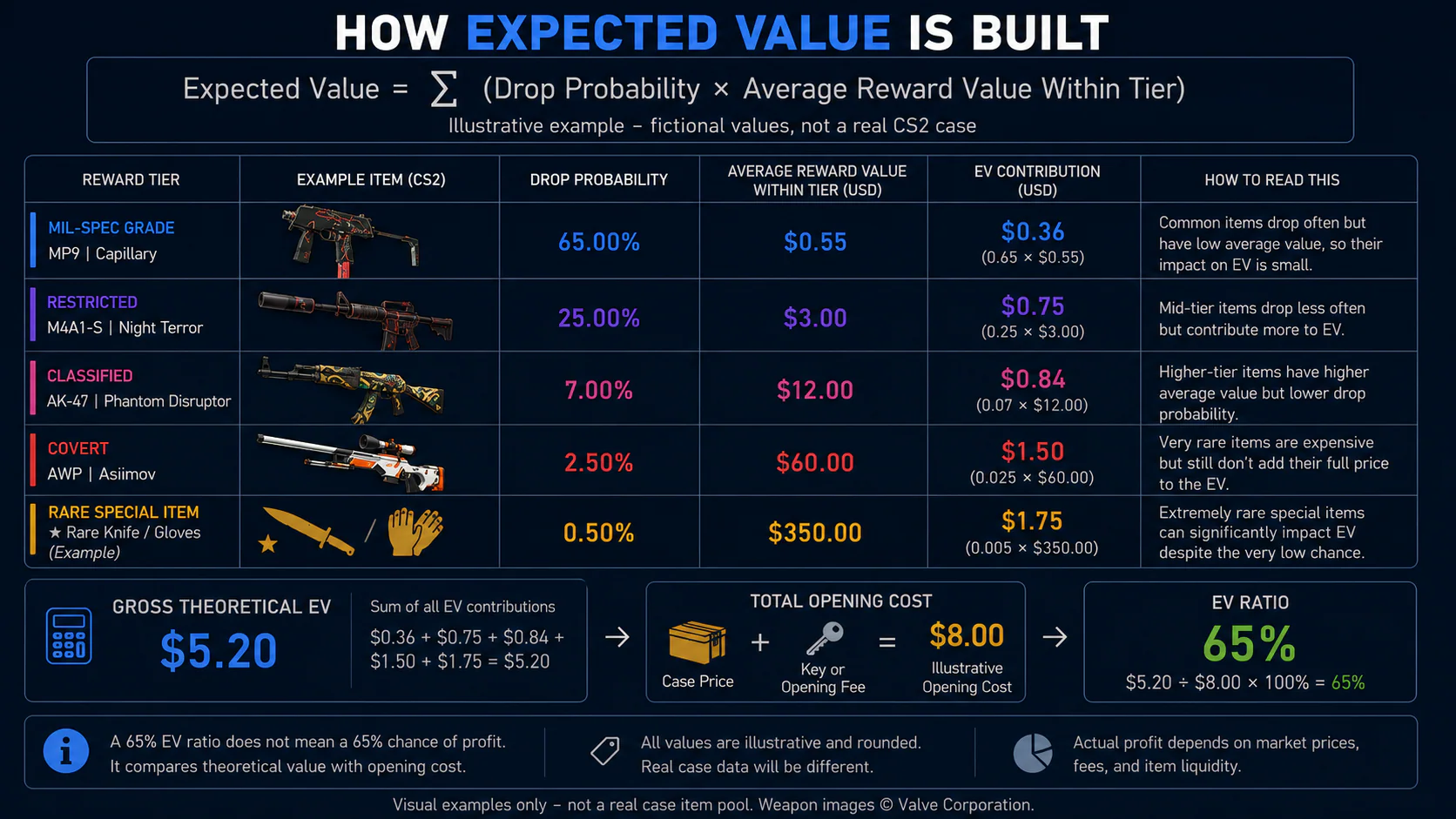
Gross theoretical EV can then be compared with the total opening cost to calculate EV ratio. An EV ratio of 65%, for example, does not mean a 65% chance of profit. EV is useful for comparing cases under the same framework, but it does not predict the next opening or guarantee a particular result.
How Case Price and EV Ratio Change the Comparison
Case price is only one part of total opening cost. Official openings may also require a key, while third-party platforms may charge a separate opening fee or include that fee in the displayed price.
The same item pool becomes more or less attractive when its opening cost changes. A cheaper case is not automatically better when most drops have little value, and an expensive case is not automatically worse when its reward pool supports higher EV.
Raw EV must therefore be compared with total opening cost. EV ratio compares expected value with the amount required to open the case, often by dividing EV by total cost. A case can have higher raw EV but a weaker EV ratio when its opening price is significantly higher.
EV ratio is useful when comparing cases at different price levels, but it still does not guarantee an individual result. For a deeper explanation, read “What Is EV Ratio in CS2 Case Opening?”
Item Pool, Rarity Tiers and Drop Distribution
The item pool is the full list of possible drops, not just the rarest or most expensive reward. A useful analysis considers common low-value outcomes, mid-tier rewards, rare premium items, and the drop chance attached to each reward or rarity tier.
Common outcomes influence CS2 case expected value because they appear frequently. A high-priced skin with an extremely low probability may add less EV than its headline price suggests, while an in-demand lower-rarity skin can contribute more.
Rare does not always mean valuable. Limited-demand rare skins may be worth less than popular lower-rarity items, so rarity, probability, and market value must be evaluated together.
The whole reward distribution matters more than the single most expensive possible drop. Clearly displayed case odds make this analysis possible. Hidden, incomplete, or unclear odds make EV difficult to assess because the probability-weighted calculation cannot be checked properly.
Market Value, Float, Wear, StatTrak and Liquidity
EV calculations depend on each reward’s estimated market price. Steam Market and third-party data provide context, but prices change with supply, demand, updates, and trading activity. Outdated prices distort gross theoretical EV.
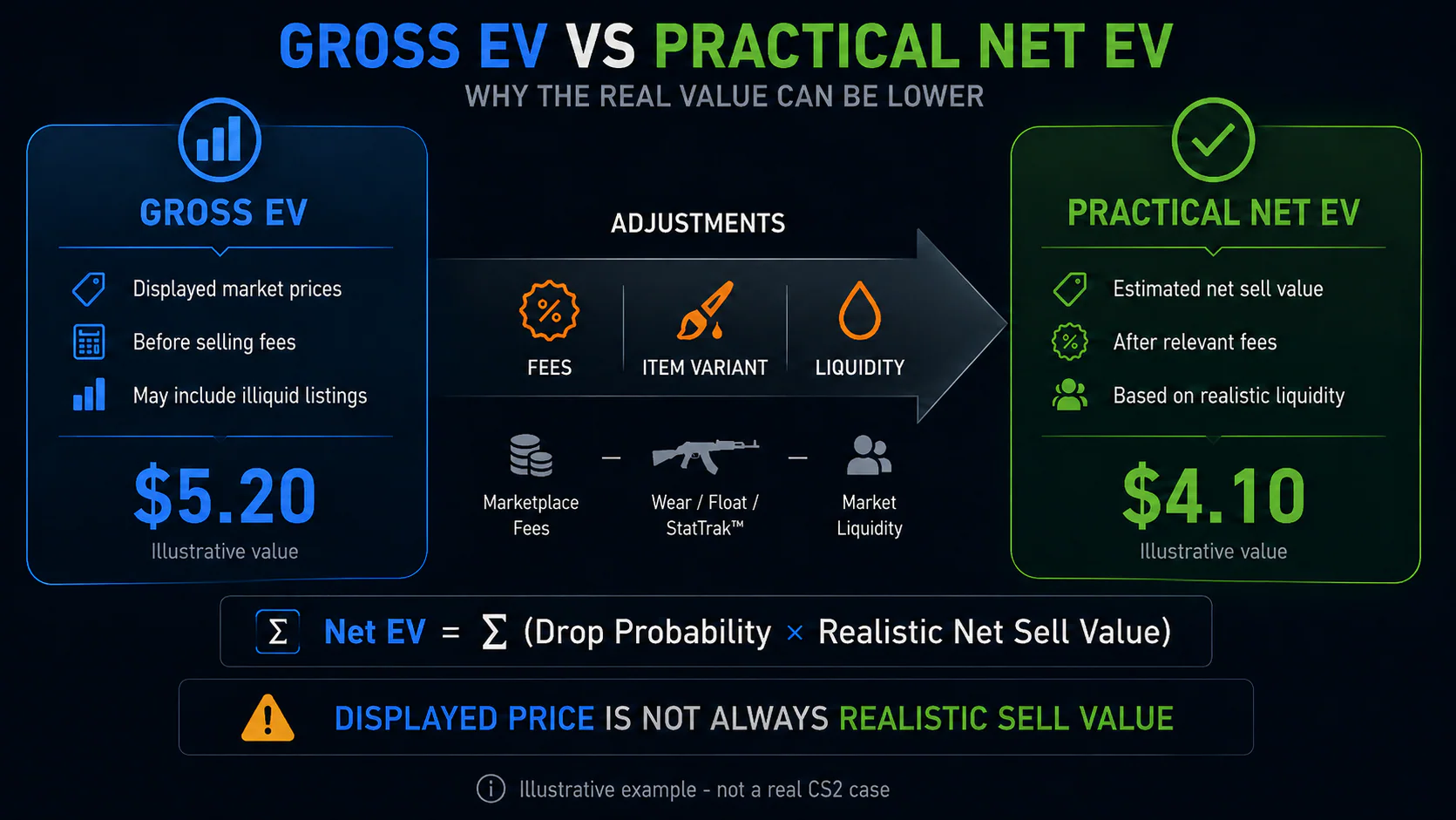
Displayed market price is also different from practical net value. Marketplace selling fees may reduce the amount received, and a high listing price does not prove that buyers regularly complete trades at that level.
Float value and wear level can create major price differences within the same skin. Factory New, Minimal Wear, Field-Tested, Well-Worn, and Battle-Scarred versions may trade at significantly different values. StatTrak versions can also have different demand and pricing from standard versions.
Accurate EV data should separate wear levels and StatTrak variants where possible rather than assigning one average value to every version of a skin.
Skin liquidity affects realistic valuation. Popular skins with regular sales are easier to price and sell, while rarely traded items may show high listings but attract few buyers. Illiquid rewards can inflate theoretical EV. Read the CS2 Skin Liquidity Guide for more about sellability and trade value.
Top-Heavy Cases, Balanced Cases and Misleading Headline Rewards
A top-heavy case receives much of its theoretical EV from extremely rare rewards. It may look attractive because it includes knives, gloves, rare AK-47 skins, or premium AWP skins, while most openings still land in the low-value part of the item pool.
Flashy artwork and previews do not reveal the full reward distribution. A case can feature an expensive top reward while offering weak common and mid-tier outcomes, so the typical result may still be disappointing.
A balanced case places more theoretical value in mid-tier items. Its headline rewards may be less dramatic, but several skins can provide support through meaningful prices and drop chances.
Balanced theoretical value does not make individual openings stable or predictable. Randomness still applies. The relevant comparison is whether value is distributed across the item pool or concentrated in one exceptionally rare result.
Why Some CS2 Cases Have Better EV
Some CS2 cases have better EV because several signals work together: reasonable total opening cost, a strong full item pool, valuable mid-tier rewards, and transparent drop chances.
Current, realistic market values matter. In-demand lower-rarity skins can strengthen the calculation when the case does not rely on one rare item. Separating wear levels and StatTrak versions improves accuracy.
Liquid rewards with regular sales also have more credible market values than items based on isolated listings. A case may compare more favorably when its EV ratio is stronger than similar cases at the same price level.
These signals are not proof that a case is profitable. They only explain why one case may compare more favorably with another. Clear item pools, visible probabilities, updated prices, and transparent case data make the comparison more reliable.
Why Better EV Does Not Guarantee Better Results
EV is a long-run theoretical measure, while individual openings are affected by variance. Small sample sizes can produce results that are much worse or much better than the expected average.
Rare rewards remain rare even in a case with comparatively strong EV. A better-EV case can still produce a low-value skin on the first opening, the tenth opening, or several openings in a row.
Previous losses do not force the next result to improve. Repeated openings do not change the underlying probabilities unless the stated case mechanics specifically say otherwise. Users should not chase losses in an attempt to recover earlier spending.
Better EV improves comparison quality. It does not provide control over drops or guarantee a better personal outcome.
Official CS2 Cases vs Third-Party Case EV
Official CS2 cases have defined item pools, with total opening cost usually affected by both the case price and key cost.
Third-party platforms may create custom item pools, set platform-specific prices, and use odds that vary by site. Visible and verifiable drop chances are essential because EV cannot be assessed properly without reliable probability data.
Practical value may be affected by fees, withdrawal rules, minimum requirements, delivery restrictions, or limits on selling rewards. Platform reputation, transparency, and withdrawal reliability matter alongside EV.
Official and third-party cases should therefore be compared separately. An attractive EV estimate does not make an untrusted platform safe. Third-party rules, pricing, odds, fees, and withdrawal conditions can also vary or change over time.
Common Mistakes and Checklist for Comparing Case EV
Beginners often focus on the top reward and overlook total opening cost, common outcomes, probability distribution, outdated prices, selling fees, wear, StatTrak differences, liquidity, and EV ratio.
It is also incorrect to assume better EV means profit, treat EV as a prediction, or chase losses after poor results.
Use this checklist when learning how to compare CS2 case EV:
Is the total opening cost reasonable?
Does the cost include the case, key, or platform opening fee?
Is the full item pool visible?
Are drop chances shown clearly?
What are the lowest-value possible drops?
Are there meaningful mid-tier rewards?
Does most theoretical value depend on one extremely rare reward?
Are market prices current?
Are listed values realistic after selling fees?
Are wear levels and StatTrak versions separated?
Are the possible skins liquid or difficult to sell?
Is EV or EV ratio available?
Are platform withdrawal rules clear?
Is the platform transparent and trustworthy?
Would buying the target skin directly be more predictable?
For related context, read “CS2 Case Opening vs Buying Skins Directly” and “CS2 Case Opening Strategy: Bankroll, EV Ratio and Risk Control.”
How Chance4Skin Can Help
Chance4Skin helps users explore CS2 cases, review item pools, compare case odds, understand drop chances, check market context, examine skin variants, evaluate EV ratio, and compare reward distributions.
These tools support a more structured case comparison before opening cases or buying skins directly. They do not predict drops or guarantee financial returns. Their purpose is to make relevant case, probability, and market data easier to inspect and understand.
FAQ
Why do some CS2 cases have better EV than others?
CS2 cases have better EV when lower opening cost, a stronger item pool, valuable mid-tier rewards, transparent odds, realistic values, or liquidity improve the comparison. Distribution matters when value is not concentrated in one rare item.
Does better EV mean I will get better drops?
No. EV is theoretical and does not predict individual outcomes. A case with better EV can still produce a low-value reward.
What affects CS2 case expected value?
EV depends on opening cost, item pool, drop chance, market prices, rarity tiers, float, wear, StatTrak variants, liquidity, fees, and reward distribution. Any input change can alter the estimate.
Is EV ratio better than raw EV?
EV ratio is often more useful for comparison because it relates expected value to total opening cost. Raw EV alone can be misleading when cases have significantly different prices.
Can a case with expensive skins have bad EV?
Yes. Expensive rewards may contribute little to EV when their drop chances are extremely low and most common outcomes have low value. The full probability distribution matters more than the top item alone.
Why do market prices matter for EV?
EV calculations depend on the estimated value of possible rewards. Outdated prices, unrealistic listings, poor liquidity, or ignored selling fees can make an EV estimate misleading.
Should I choose CS2 cases only by EV?
No. Users should also examine odds transparency, item pool quality, liquidity, total cost, platform trust, withdrawal rules, and whether buying a desired skin directly is more predictable.
Can Chance4Skin help compare case EV?
Chance4Skin can help users review CS2 case odds, drop chances, item pools, market context, EV ratio, and skin values before comparing cases. It supports analysis but does not predict individual drops.
Written by
Team Chance4Skin


